


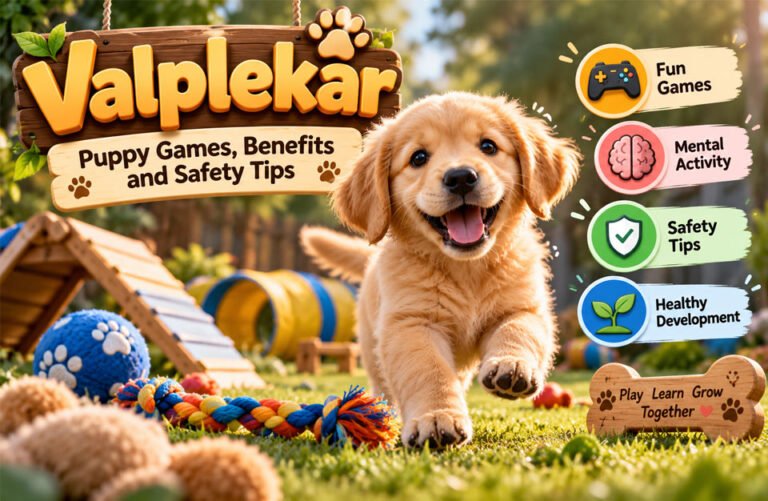
Valplekar is a Swedish term linked with games and play for puppies. It can include simple activities like finding food, playing with toys, exploring safe places, and spending time with an owner.
People may search for Valplekar to learn what it means and what games are good for puppies. Some websites also give the word other meanings, which can make the topic confusing.
This guide explains Valplekar, its benefits, the best puppy games, training, socialisation, safety, rest, and common mistakes.
What Is Valplekar?
Valplekar is a Swedish term linked with puppy games and puppy play. It covers simple activities that let a puppy play, move, explore, and spend time with people.
For example, a puppy may search for food, carry a soft toy, play gentle tug, find its owner during hide-and-seek, or explore a safe room.
Valplekar does not need expensive toys or special equipment. A safe space, a suitable toy, and some of the puppy’s normal food can be enough.
It is also not one specific game. Every puppy is different. One puppy may enjoy chasing toys, while another may prefer sniffing and searching.
Games should match the puppy’s age, size, health, confidence, and personality.
Valplekar should not be treated as the official name of a special puppy program. Its clearest meaning is simply puppy games and playful activities.
What Does Valplekar Mean in Swedish?
The Swedish words behind Valplekar help explain its meaning.
Valp means puppy. Lek is linked with play, while lekar means games or playful activities.
This makes puppy games or puppy play a simple way to understand Valplekar.
The meaning also fits activities for young dogs, such as playing with toys, searching for food, exploring, and doing simple training games.
The word can become confusing on English websites because some sites give it other meanings. However, its Swedish connection with puppies and games is the clearest way to understand it.
Why Is Valplekar Important for Puppies?
Play is a normal part of a puppy’s early life. Puppies learn about the world by smelling, touching, moving, watching, and interacting.
Valplekar gives them safe ways to do these things.
Following a toy, walking on safe surfaces, and searching for food can help a puppy use its body. These activities involve movement, balance, and coordination.
Games can also keep a puppy’s mind active. For example, searching for hidden food uses its sense of smell. Hide-and-seek can use attention, memory, hearing, and smell.
Not every game needs lots of movement. A scent game can keep a puppy busy without making it run. Fetch usually involves more physical activity.
Play can also give puppies something useful to do with their energy. Without suitable activities, some puppies may become restless, chew things, bite hands, or bark for attention.
However, play is only one part of puppy care. Puppies also need good food, sleep, training, social experiences, veterinary care, and a regular routine.
How Valplekar Helps Build Trust
Playing together can help an owner and puppy get to know each other.
During a game, the puppy learns how the owner speaks, moves, and responds. The owner also learns which games the puppy enjoys and which ones make it uncomfortable.
Good experiences can help the puppy enjoy spending time with its owner.
For example, the puppy may get a small food reward after responding to its name. It may also get another turn with a toy after returning to the owner.
Rewards do not always need to be food. A puppy may enjoy praise, another turn with a toy, or gentle attention.
Owners should also respect when a puppy wants to stop. The puppy should be able to move away or take a break.
This is especially important for shy or new puppies. Games should feel safe and comfortable instead of difficult or stressful.
Best Valplekar Games for Puppies
There is no single game that is best for every puppy. Try different activities and see what your puppy enjoys.
Name Game
The name game is very simple.
Start in a quiet place. Say the puppy’s name once. When the puppy looks at you, give it a small reward.
Keep the game short. Do not keep repeating the puppy’s name if it is not paying attention. Wait for a calmer moment and try again.
This game can teach the puppy that looking at its owner after hearing its name brings a good result.
Hide-and-Seek
Hide-and-seek can be played safely inside the home.
Another person can stay with the puppy while you hide nearby. Call the puppy in a friendly voice. When it finds you, give praise or a small reward.
Start with an easy hiding place. You can slowly make the game a little harder as the puppy learns what to do.
The game can use the puppy’s smell, hearing, attention, and memory. It can also help make coming toward the owner a positive experience.
Do not hide in places that require the puppy to climb furniture, use unsafe stairs, or enter dangerous areas.
Gentle Tug
Some puppies enjoy playing tug with a soft dog toy.
Keep the toy low so the puppy’s feet stay on the floor. Let the puppy pull gently.
Do not pull hard, twist the toy strongly, shake the puppy, or lift it from the floor. Rough movements can put extra pressure on a young puppy’s teeth, neck, and body.
You can also teach the puppy to release the toy. Stop moving it and offer a small food reward in exchange. Later, you can add a simple word such as “drop.”
Do not force the puppy’s mouth open.
Short Fetch Games
Start fetch by rolling a soft toy a short distance.
Let the puppy follow the toy and explore it. If it picks up the toy, encourage it to come back toward you.
Give a reward when the puppy returns, even if it does not bring the toy all the way back.
Young puppies may not understand fetch straight away. Some puppies like chasing a toy but do not want to bring it back. This is normal.
Do not chase the puppy to take the toy away. The puppy may learn that running away from you is part of the game.
Keep throws low and short. Avoid high throws, repeated jumping, and sharp turns.
Scent and Food Games
Dogs naturally use their sense of smell to explore.
A simple scent game is to put a few pieces of the puppy’s normal food on a clean floor or mat. Let the puppy find them.
When the puppy understands the game, you can make the search slightly harder. For example, food can be partly hidden behind a safe object.
You can also place food under a safe lightweight cup or inside a loosely folded towel.
Do not make the game too difficult. If the puppy becomes frustrated, make the search easier.
Food used during games should be counted as part of the puppy’s normal daily food. Always supervise games involving cups, towels, or other objects that the puppy might chew.
Nose-Touch Game
Hold your open hand near the puppy’s nose without pushing it toward the puppy.
Many puppies will move forward and smell the hand. Give a reward when the puppy’s nose touches your palm.
Once the puppy understands the game, you can add the word “touch.”
This skill can later help you gently guide the puppy without pulling it.
Keep the activity calm. If the puppy starts biting your fingers or becomes too excited, pause the game.
Indoor Valplekar Ideas
Many puppy games can be played indoors.
Good options include hide-and-seek, scent games, gentle tug, short fetch, name games, nose touches, and safe exploration.
Indoor games are useful when the weather is bad or when the puppy needs a calmer activity.
Make sure there is enough safe space. Running quickly around furniture or across slippery floors can cause problems. A secure rug can give the puppy better grip.
Remove cables, small objects, shoes, unsafe products, and other things the puppy could chew or swallow.
Indoor play does not always need lots of movement. Scent games and simple training activities can keep a puppy’s mind busy in a small space.
Outdoor Valplekar and Exploration
Outdoor play gives puppies a chance to experience new smells, sounds, surfaces, and places.
Outdoor Valplekar does not always mean running. A puppy can sniff, explore a safe space, walk calmly, or simply watch what is happening around it.
Short toy games can also be played outside when the area is safe.
Think about the weather, temperature, ground, traffic, and other animals before choosing a place.
Young puppies should not be pushed into hard exercise just because they have lots of energy.
Vaccinations are also important. Some outdoor places may not be suitable while a puppy is still getting its vaccinations.
Ask a veterinarian if you are unsure where your puppy can safely explore.
Valplekar and Puppy Training
Valplekar and puppy training can work together, but they are not the same thing.
Training usually has a clear goal. For example, you may want the puppy to respond to its name, come when called, release a toy, sit calmly, or follow household rules.
Play is usually more relaxed. A puppy may chase a toy simply because it enjoys doing so.
However, games can help with training.
The name game can teach attention. Hide-and-seek can make coming toward the owner rewarding. Trading during tug can help teach a puppy to release objects. Nose-touch games can help with gentle guidance.
Scent games can also help puppies focus and explore.
Not every game needs to become a training lesson. Puppies should also have time to play simply because they enjoy it.
There is no clear evidence that Valplekar is a separate formal Swedish puppy-training system. It is better understood as puppy play that can sometimes support training.
Valplekar and Puppy Socialisation
Puppy socialisation is more than letting a puppy play with other dogs.
It can include safe experiences with people, sounds, objects, surfaces, places, handling, and suitable animals.
Valplekar can be part of this process. A puppy may explore a new safe place, meet someone during a calm game, or play with another suitable dog.
Every puppy has a different level of confidence. A shy puppy may need more time to watch before joining an activity.
Do not force a scared or uncomfortable puppy to interact. Calm and manageable experiences are usually more useful than many stressful ones.
Playing With Other Puppies and Dogs
Playing with another puppy or suitable dog can help a young dog experience social interaction.
However, not every dog is a good play partner.
Think about the dogs’ size, age, health, personality, confidence, energy, and play style.
A large, energetic puppy may be too much for a smaller or quieter puppy.
Watch both dogs during play. Comfortable play may include relaxed movement, short breaks, and chances for either dog to move away.
Signs of a problem can include constant chasing, cornering, hiding, crying, stiff movement, defensive snapping, or repeated attempts to escape.
Growling can sometimes happen during normal play. Look at the dog’s whole body and behavior instead of judging the situation only by the sound.
If one puppy looks scared or keeps trying to leave, stop or pause the game calmly.
The goal is not to make a puppy meet as many dogs as possible. A few safe and comfortable experiences can be more useful.
How to Make Valplekar Safe
Check the area before starting any puppy game.
Remove electrical cables, sharp objects, small items, unsafe products, and anything the puppy could swallow.
Choose toys that are suitable for the puppy’s size. Check them regularly for damage or loose pieces. Remove a toy if parts could break off.
The floor should have enough grip. A secure rug can help on smooth indoor floors.
Growing puppies do not need lots of jumping, sharp turns, or hard exercise. Keep physical games gentle and suitable for the puppy’s development.
Watch the puppy when introducing new toys or games. This is especially important with towels, cups, puzzles, and other objects it may try to chew.
Keep fresh water available.
If the puppy has an injury, health problem, unusual movement, or trouble during exercise, speak with a veterinarian.
How to Tell When Your Puppy Needs a Break
Puppies need plenty of sleep and rest.
A tired puppy does not always become quiet. Some puppies actually become more active when they need rest.
They may run around, bite harder, or find it difficult to settle. This can look like a need for more play, but the puppy may actually be tired.
Other signs can include yawning, losing interest, moving slowly, hiding, or finding it hard to follow simple instructions.
Heavy panting during gentle play can also be a reason to stop.
Do not try to make every play session last for a fixed amount of time. Watch the puppy instead.
If it becomes tired, worried, uncomfortable, or uninterested, end the game and let it rest.
Understanding Puppy Body Language During Play
A puppy’s body language can help you understand whether it wants to keep playing.
A comfortable puppy may have relaxed movement and a relaxed face. It may return to you when you pause the game.
A play bow, where the front of the body goes down while the back stays raised, can be an invitation to play.
Do not judge a puppy only by its wagging tail. Look at its whole body.
A puppy may need space if it becomes stiff, turns away, tucks its tail, or keeps trying to leave.
Lip licking and yawning can sometimes be signs of discomfort, depending on the situation.
Good Valplekar allows the puppy to choose. When you stop the game, it should be free to return or walk away.
How to Handle Play Biting
Puppies often use their mouths while playing and exploring.
Keep suitable toys nearby. If the puppy starts biting hands or clothing, guide its attention toward a toy.
If its teeth touch your skin, stay calm. You can pause the game for a short time.
Do not use your hands as toys. This can make biting harder to manage as the puppy gets bigger.
Avoid shouting, hitting, or holding the puppy’s mouth shut. These actions can scare the puppy and do not show it what it should bite instead.
If biting becomes stronger near the end of a game, the puppy may be tired or too excited. It may need quiet time instead of more play.
Children should be supervised when playing with puppies.
Speak with a veterinarian or suitable professional if biting is very strong, worrying, or linked with pain or unusual behavior.
Play, Exercise, and Rest
Play, exercise, and rest are connected, but they are different.
Exercise mainly means physical movement.
Play can include movement, sniffing, exploring, thinking, communication, and social interaction.
For example, a puppy may slowly search for hidden food. It is not running much, but its mind is still active.
Fetch usually requires more physical movement.
Rest is also very important. Puppies are still growing and need time to recover from activity and new experiences.
The goal of Valplekar is not to make a puppy completely tired.
Try to balance physical movement, mental activity, calm time, and sleep.
Building a Balanced Valplekar Routine
There is no perfect play schedule for every puppy.
Age, breed, health, personality, confidence, development, and energy all matter.
Several short activities during the day may be better than one long session.
For example, a puppy might play the name game in the morning, do a scent game later, and enjoy gentle toy play at another time.
Mix active games with calmer activities.
For young or new puppies, you can start with only a few minutes. Stop sooner if the puppy becomes tired, worried, distracted, frustrated, or loses interest.
Do not wake a sleeping puppy simply because you planned a game. Sleep is important.
People in the home should also try to follow the same basic rules. Different rules can make learning harder for the puppy.
Common Valplekar Mistakes to Avoid
Some common mistakes include:
- Playing for too long.
- Making every game very active.
- Using hands as toys.
- Chasing the puppy to get a toy back.
- Pulling too hard during tug.
- Encouraging high jumps or sharp turns.
- Playing on slippery floors.
- Using broken or unsuitable toys.
- Giving too many extra treats.
- Forcing the puppy to play with other dogs.
- Ignoring fear or tiredness.
- Expecting every puppy to enjoy the same games.
- Making every game into a training lesson.
- Giving the puppy too much activity and too little rest.
Valplekar should be flexible. If a game does not suit your puppy, make it easier, choose another activity, or stop.
Why Is Valplekar Confusing Online?
Different meanings of Valplekar can be found online.
The Swedish language gives the word a clear connection with puppies and games. However, some websites describe Valplekar as a cultural tradition, place, surname, or special training method.
These different meanings should not be mixed together without evidence.
Information can also be copied from one website to another. Seeing the same claim on several pages does not always mean it is correct.
Each meaning needs reliable evidence.
Is Valplekar a Cultural Tradition?
Some online descriptions present Valplekar as an old tradition linked with farming, harvest celebrations, music, dancing, crafts, spirituality, marriage customs, storytelling, and family life.
However, the information collected for this article does not provide strong historical or academic evidence for a specific culture or tradition called Valplekar.
A real cultural tradition would normally have evidence such as historical records, known communities, locations, archives, artifacts, or academic research.
For now, this meaning is better treated as an unconfirmed online claim.
Is Valplekar a Place?
Some websites reportedly describe Valplekar as a place or travel destination.
However, the information collected for this article does not confirm a town, village, district, or region with this name.
A real location would normally appear in reliable maps, government records, postal information, or other trusted geographical sources.
A travel-style article alone does not prove that a place exists.
For this reason, Valplekar should not be called a confirmed geographical location without better evidence.
Is Valplekar a Surname?
Some online information also describes Valplekar as a surname.
The information collected for this article does not provide enough historical or family records to confirm its origin as a surname.
Even if the same spelling is used as a family name somewhere, it does not mean that it is connected with the Swedish puppy-play meaning.
More reliable family and historical records would be needed to confirm this claim.
Is Valplekar a Formal Training Method?
There is no clear evidence that Valplekar is an official dog-training system.
The information collected does not show a known founder, official organization, certification, fixed program, or professional training standard connected with Valplekar.
Puppy games can help with training, but this does not make Valplekar a separate training method.
It is better understood as puppy play that can be used alongside normal puppy training.
The Most Accurate Way to Understand Valplekar
The simplest way to understand Valplekar is through its Swedish meaning.
The term connects puppies with games and playful activities. It can include scent games, toy play, hide-and-seek, safe exploration, simple training games, and suitable social play.
There is no fixed Valplekar routine that every puppy must follow.
Puppies have different ages, health needs, personalities, confidence levels, and interests. Games should match the individual puppy.
Other meanings found online should be kept separate unless reliable evidence supports them.
Bottom Line
Valplekar is best understood as a Swedish term for puppy games and puppy play.
It can include scent games, hide-and-seek, gentle tug, short fetch, exploration, and simple training activities.
Good Valplekar should be safe and suitable for the individual puppy. Owners should use suitable toys, watch their puppy during play, and stop when it becomes tired or uncomfortable.
Play can support movement, mental activity, learning, and positive interaction. However, puppies also need plenty of sleep and quiet time.
Other meanings of Valplekar appear online, but there is not enough reliable evidence in the collected information to confirm it as an ancient culture, geographical place, surname origin, or formal Swedish training system.
Frequently Asked Questions
What does Valplekar mean?
Valplekar means puppy games or puppy play. It comes from Swedish words linked with puppies and games.
Is Valplekar a Swedish word?
Yes, Valplekar has a Swedish language connection. Valp means puppy, and lekar means games or playful activities.
What are the best Valplekar games for puppies?
Good games include hide-and-seek, gentle tug, short fetch, scent games, and name games.
Can Valplekar help with puppy training?
Yes. These games can help puppies learn attention, recall, and simple commands while playing.
How long should a Valplekar session last?
Keep play sessions short. Stop when your puppy becomes tired, worried, or loses interest.
Is it safe for puppies to play together?
Yes, if the puppies are comfortable and supervised. Stop the game if one puppy becomes scared or tries to leave.
How do I know when my puppy is tired of playing?
A tired puppy may yawn, slow down, hide, bite more, or lose interest. Give it time to rest.
Is Valplekar a formal Swedish puppy-training method?
No formal Valplekar training system has been confirmed. It is better understood as puppy games and playful activities.
Discover More:
