


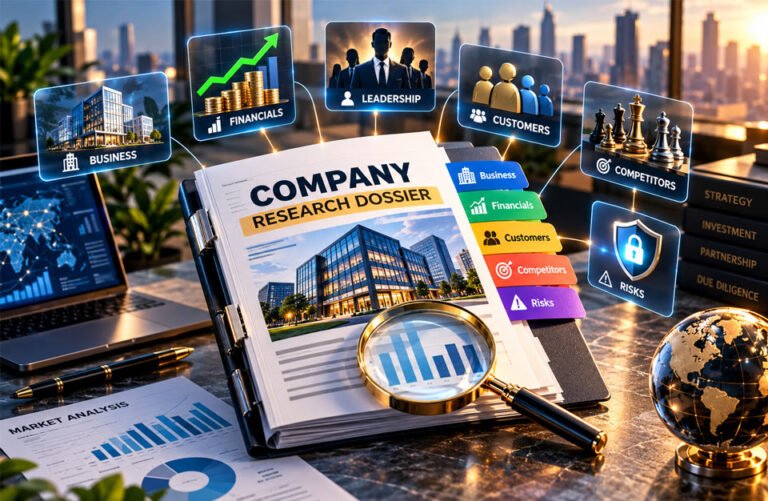
A research dossier for a target company is a report that collects important information about a business in one place.
It may cover the company’s owners, finances, products, customers, competitors, daily operations, and possible risks.
People prepare these reports before investing in a business, choosing a supplier, starting a partnership, or buying a company.
The main goal is to understand the business, find possible problems, and identify details that need further checking.
This guide explains what a company research dossier is, what it should include, and how to prepare one using reliable information.
What Is a Research Dossier for a Target Company?
A research dossier is a report that collects and explains information about a business.
The target company is simply the company being studied. It does not always mean Target Corporation.
The report may cover the company’s name, owners, history, products, customers, leaders, finances, competitors, and legal matters.
It should also explain which details are missing or cannot be confirmed.
A dossier does more than collect facts. It explains why the information matters.
For example, a company’s sales may be growing while its profits are falling. It may also have high debt or depend on one major customer. Studying these details together gives a clearer picture of the business.
Important claims should be supported by reliable sources. If something cannot be confirmed, mark it as unknown, estimated, or unverified.
A good dossier should answer four main questions:
- What do we know about the company?
- What does the information tell us?
- What important details are missing?
- What should we check next?
The amount of research depends on the purpose. A basic supplier check may need a short report. Research for a major investment or company purchase may require much more work.
Research Dossier vs Company Profile vs Due Diligence
These three terms are related, but they have different meanings.
A company profile gives basic information about a business. It may include the company’s history, location, products, services, and leaders.
A research dossier goes deeper. It checks information from different sources, compares facts, finds possible risks, and explains what the findings mean.
Due diligence involves more detailed checks. It may include private financial records, contracts, tax documents, legal records, and technical information.
A research dossier can help identify areas that need more checking before due diligence begins.
However, public information cannot confirm private details that the researcher cannot access.
Why Create a Research Dossier?
A research dossier helps people understand a company before making an important decision.
An investor may use it to check the company’s sales, profits, debt, cash flow, management, competitors, and risks.
A business may prepare one before starting a partnership. It can help check the other company’s ownership, finances, reputation, and ability to do the agreed work.
A company may also research a supplier before placing a large order. It may check the supplier’s financial health, production capacity, delivery record, and security practices.
Sales teams can use a dossier before contacting another business. They may research its products, leaders, recent changes, and possible business needs.
A dossier can also help compare competitors. Businesses can study their products, prices, customers, and services.
The information included should depend on the reason for the research.
Define the Research Goal First
Before starting, decide what you want to learn about the company.
For example, when checking a supplier, you may ask:
Can this company supply our business reliably for three years?
This question helps you focus on the most useful details. You may need to check its finances, production, suppliers, delivery record, and daily operations.
Research for buying a company will be different. You may need to study its owners, debts, contracts, taxes, and profits.
A sales dossier may focus on company leaders, business goals, recent changes, and useful questions for a meeting.
You should also decide the research deadline, the market you want to study, and the date covered by the report.
Before starting, write down a few important questions:
- How does the company make money?
- Is its financial position improving or getting worse?
- What are its main risks?
- Does it depend on a few customers or suppliers?
- What information still needs to be checked?
Some details may not be publicly available. If you cannot find reliable information, mark the question as unanswered instead of guessing.
Company Identity, Ownership, and History
First, make sure you have identified the correct company.
A company’s brand name may be different from its legal name. Large businesses may also have several related companies.
When available, record the company’s legal name, trading name, registration number, country, main office, website, current status, parent company, and important subsidiaries.
Official registration numbers help distinguish companies with similar names.
Ownership research may include major shareholders, parent companies, and the people who control the business, if these details are available.
A complicated ownership structure does not automatically mean something is wrong. Large companies often use several legal entities.
The company’s history should include important events, such as its founding, funding, acquisitions, ownership changes, new products, expansion, and leadership changes.
The date a company was registered may be different from the date it started trading.
Check important historical details against official records and reliable sources whenever possible.
Business Model, Products, and Customers
A research dossier should explain how the company makes money.
Start with two simple questions:
What does the company sell?
Who pays for it?
A company may earn money by selling products, offering subscriptions, providing services, showing advertisements, licensing technology, or charging fees.
Some businesses use several of these methods.
The dossier should explain the company’s main products and services, who uses them, and what problems they solve.
Customers may include individuals, small businesses, large companies, or government organizations.
The countries where a company operates also matter. Depending heavily on one country may create different risks from operating in several markets.
Check whether customers make one-time purchases or buy regularly.
Customer dependence is another important point. If one customer provides a large share of the company’s income, losing that customer could cause serious problems.
Pricing can help explain how the company competes with other businesses. However, prices agreed in private contracts may not be available.
The research should also explain why customers choose the company and why they might leave. Price, quality, service, convenience, technology, and customer loyalty may all play a role.
Leadership, Employees, and Governance
Leadership research focuses on the people who run the company.
The report may include founders, the CEO, senior managers, directors, and other important decision-makers.
Check their current roles, work history, responsibilities, and how long they have worked for the company.
Always check dates because an old company page may list someone who no longer works there.
Governance means how a company is managed and controlled. It may include the board of directors, management oversight, and plans for replacing important leaders.
It is also useful to check whether the company depends too much on one person.
Employee numbers can help show the size of a business, but different sources may report different figures.
For example, one source may count only employees, while another may also include contractors.
Professional profiles and job advertisements can provide useful clues about hiring and company growth.
However, a job advertisement does not prove why a company is hiring or whether it has a problem.
Financial Performance and Financial Health
Financial research helps show how well a company is doing.
When possible, compare several years instead of looking at only one period.
Important figures may include sales, profit, costs, cash flow, debt, and available cash.
EBITDA may also help when studying some companies, but it should not be the only measure of financial health.
Sales alone do not tell the whole story.
A company may sell more products but earn less profit because its costs are rising.
Cash flow is also important. A company may report a profit but still struggle to pay its bills.
Check the company’s debt, interest costs, repayment dates, and ability to pay what it owes.
Funding announcements can help explain how a new company has raised money. However, the amount raised in the past does not show how much money remains today.
For every important financial figure, record the currency, reporting period, and source.
Also explain whether the figure comes from audited accounts, company statements, or an outside estimate.
Public vs Private Company Research
Public companies usually share more financial information than private companies.
In the United States, many public companies publish reports through the SEC’s EDGAR system. Form 10-K reports provide yearly business and financial details. Form 10-Q reports provide quarterly updates.
Other countries have their own systems.
In the UK, Companies House provides company records, including filings, officers, previous names, charges, and some insolvency information.
Private companies may share much less information.
When allowed and appropriate, researchers can ask the company for financial reports, debt details, contracts, or other important documents.
Other information may provide useful clues. These include funding announcements, hiring, acquisitions, new offices, website traffic, and estimated employee numbers.
However, these clues have limits.
Website traffic does not prove sales. Employee numbers do not prove profits. A funding announcement does not show how much money the company still has.
If reliable financial details cannot be found, clearly state that they could not be confirmed.
Market Position and Competitor Analysis
A company should also be studied alongside other businesses in its market.
First, decide which market the company serves.
A company may be strong in one small market but have a much smaller position in the wider industry.
Choose competitors that sell similar products or services to similar customers.
Companies in the same industry are not always direct competitors. They may serve different countries, customer groups, or price ranges.
Useful comparisons include products, prices, customers, locations, delivery, and service quality.
Market-share figures also need careful checking.
A company’s share of one country’s market may be very different from its share of the global market.
Claims such as “market leader,” “number one,” or “fastest growing” should be checked before being accepted as facts.
Also consider other choices available to customers. They may choose another company, use an older product, build their own solution, or decide not to buy anything.
Competitive Advantage and Market Moat
A competitive advantage is something that helps a company compete with other businesses.
It may include a strong brand, special technology, patents, lower costs, good distribution, loyal customers, useful partnerships, or expert knowledge.
A market moat is an advantage that competitors may find difficult to copy.
These advantages need evidence.
A patent does not automatically mean a company has better technology. A famous brand does not guarantee that customers will stay.
Researchers should ask simple questions.
Can competitors copy the product? Can customers easily switch to another company? Does the business have special technology or partnerships that others cannot easily access?
A strong advantage should have a clear effect on customers, sales, costs, or the company’s position in the market.
Operations, Suppliers, and Technology
Financial reports do not explain everything about how a company works.
Operational research looks at how the company makes and delivers its products or services.
Important areas may include buildings, equipment, employees, production, transport, suppliers, and quality checks.
For a manufacturer, researchers may need to study its factories, production capacity, and suppliers.
For a technology company, they may check its software, hosting services, outside platforms, backups, and recovery systems.
Depending on one supplier or service can create problems. If that supplier stops working, the company may struggle to continue its normal operations.
Technology ownership is also important.
Researchers should check whether the company owns its important software and technology, pays to use another company’s technology, or depends on outside services.
These details help show whether the company can continue serving its customers reliably.
Cybersecurity, Data, and Vendor Risk
Cybersecurity matters when a company handles customer details, payments, private business information, or access to computer systems.
Researchers can check for security policies, plans for handling attacks, independent security reviews, and backup systems.
Outside service providers also matter.
A company may depend on cloud services, payment providers, software companies, or contractors. A problem at one of these providers may affect the company.
Supplier checks can include security practices, plans for keeping the business running, ownership, and important supply relationships.
Data privacy should also be checked when relevant. Researchers may review the company’s privacy policy, the types of information it collects, and any known data breaches.
A company’s claim that its systems are secure is not enough on its own.
For important business decisions, security reports, certificates, contracts, or independent reviews may be needed.
Legal, Regulatory, and Compliance Checks
Legal research helps identify issues that could affect a company.
First, check that the correct legal company is registered and review its current status.
Some industries also require special licenses or government approval.
Registering a company does not mean it has every license needed to operate.
Researchers may also check court cases, government investigations, insolvency records, contract disputes, and official penalties.
Legal information must be explained carefully.
A lawsuit does not automatically mean a company has done something wrong. Separate allegations from court decisions, settlements, dismissed cases, and official findings.
Sanctions checks may also be useful when dealing with international companies.
A similar name is not enough to prove that a person or company is on a sanctions list. Other identifying details must be checked.
Do not claim that a company has never faced legal action unless the available evidence supports that statement.
For serious legal matters, advice from a qualified lawyer may be needed.
Reputation and Customer Feedback
A company’s reputation can affect its customers, employees, and business relationships.
Researchers may check news reports, customer reviews, complaints, public disputes, and company responses.
One bad review does not prove that a company provides poor service to everyone.
Look for similar complaints across reliable sources and check how recent they are.
Online reviews may sometimes be fake or misleading, so they should be checked carefully.
News reports can also provide information about funding, acquisitions, changes in leadership, investigations, and disputes.
Always check the date and final result of an event.
For example, an announcement about a planned purchase does not prove that the deal was completed.
Growth Opportunities and Future Strategy
A research dossier can also explain how a company plans to grow.
Possible plans include launching new products, entering new countries, finding new customers, improving technology, forming partnerships, or buying another business.
Hiring and opening new offices may provide clues about expansion.
However, plans are not the same as results.
If a company says it plans to enter a new country, record this as a plan. Do not assume that the expansion will succeed.
The same rule applies to new products, partnerships, and acquisitions.
Clearly separate completed actions from future plans.
How to Find Reliable Company Information
Reliable sources are important when preparing a company research dossier.
Start with official records whenever possible.
Useful sources include company registers, government records, financial reports, regulatory filings, court records, and official company documents.
Company announcements can show what the business has publicly stated. However, important claims should be checked against other sources when possible.
Independent news reports and market research can provide more information.
Professional profiles may help confirm employees’ work history. Job advertisements may show which skills a company needs.
Technology tools can sometimes identify software used on a company’s public website.
However, these sources have limits.
A job advertisement does not prove that the company uses that software across its entire business.
Always check when the information was published. Even a reliable source can contain outdated details.
How to Build an Evidence Register
An evidence register helps keep research clear and organized.
For each important claim, record what it says and which company it concerns.
Also record the original source, document location, reporting date, and the date you checked it.
You can label information as:
- Confirmed fact
- Company statement
- Outside report
- Estimate
- Interpretation
- Unverified claim
Record any supporting or conflicting information as well.
A confidence level can help show how reliable a finding appears to be.
Remember that the date a report was published may be different from the date you accessed it.
Finding an old report today does not make its information current.
Try to find the original source of each important claim. If several websites repeat the same announcement, they do not necessarily provide separate confirmation.
How to Handle Conflicting Information
Different sources may provide different facts, dates, or numbers.
For example, one source may report $8 million in sales while another reports $11 million.
Do not simply choose one number or calculate an average.
First, check whether both figures cover the same year, currency, company, and financial measure.
One figure may cover the whole company group, while another covers only one part of it.
One may come from official accounts, while the other is an estimate.
The same checks apply to employee numbers, ownership, market share, and company history.
Use the more reliable source when there is a clear reason.
If you cannot explain the difference, state that the information remains uncertain.
How to Analyze Company Risks
Risk analysis explains what could go wrong and how it might affect the business.
Financial Risk
Financial risks include high debt, low cash reserves, falling profits, weak cash flow, or dependence on a few customers.
A company may be growing but still face problems if one customer provides a large share of its income.
Operational Risk
Operational risks can affect the company’s daily work.
Examples include supplier problems, staff shortages, broken equipment, production delays, and delivery problems.
Legal and Compliance Risk
These risks may include licensing issues, lawsuits, government investigations, contract disputes, or failure to follow rules.
Their importance depends on the facts and the company’s industry.
Strategic Risk
Strategic risks affect the company’s future.
Examples include stronger competitors, changing customer needs, new technology, or a shrinking market.
Cybersecurity Risk
Cybersecurity risks include data breaches, weak security systems, poor recovery plans, and problems with outside technology providers.
Reputational Risk
Repeated complaints, serious disputes, or official findings may damage customer trust.
However, negative news alone does not prove that a company is high risk. The evidence must be checked first.
Risks can be rated as low, moderate, high, or critical.
Each rating should have a clear reason and supporting evidence.
Missing Information and Unanswered Questions
Missing information does not automatically mean that something is wrong.
For example, if reliable profit figures cannot be found for a private company, state that its profits could not be confirmed.
Do not claim that the company is losing money without evidence.
Focus on missing details that could change the final decision.
The report should explain what is needed to answer important questions.
This may include financial reports, contracts, ownership documents, customer information, or security records.
Sometimes, an important decision should wait until the missing information has been checked.
If the information remains unavailable, explain how this affects confidence in the final assessment.
How to Create a Research Dossier Step by Step
Follow these steps to prepare a clear and useful company research dossier.
Step 1: Define the goal. Decide what you need to learn about the company.
Step 2: Confirm the company. Check its legal name, registration details, location, and related companies.
Step 3: Collect official records. Find financial reports, company filings, government records, and official announcements.
Step 4: Check other reliable sources. Use trusted news reports, market research, and interviews when useful.
Step 5: Organize the information. Group details about the business, finances, market, leaders, operations, and legal matters.
Step 6: Check important claims. Verify facts that could affect the decision.
Step 7: Review conflicting information. Find out why sources give different answers.
Step 8: Study the finances. Compare results over time and investigate unusual changes.
Step 9: Compare competitors. Study similar companies and other options available to customers.
Step 10: Identify risks and gaps. Focus on issues that could change the decision.
Step 11: Record evidence and risks. Keep sources, findings, and follow-up questions organized.
Step 12: Write the final report. Explain the main findings, risks, missing information, and next steps.
The final recommendation should be based on evidence rather than guesses.
Recommended Research Dossier Format
There is no single format for every research dossier.
A useful report may include:
- Executive summary
- Research goal and scope
- Company identity and history
- Ownership and leadership
- Business model, products, and customers
- Financial review
- Market and competitors
- Operations and technology
- Legal and regulatory checks
- Reputation
- Risk analysis
- Growth opportunities
- Missing information
- Final recommendation
- Sources and supporting documents
Include the date the report was prepared and the date covered by the research.
You may also include the researcher’s name and any confidentiality rules.
There is no fixed page length.
A basic company check may need only a few pages. Research for a large investment or acquisition may require a much longer report.
It is often better to write the executive summary after finishing the research. This helps you focus on the most important findings and risks.
Common Mistakes to Avoid
One common mistake is relying only on the company’s website and marketing material.
These sources can be useful, but they usually present the company in a positive way.
Do not present estimated sales, employee numbers, website traffic, or market share as confirmed facts.
Make sure you are researching the correct legal company.
Check dates so you do not use old financial, ownership, or leadership details as current information.
Do not assume that higher sales always mean higher profits.
Do not present allegations as proven facts.
Use indirect clues carefully.
For example, a cybersecurity job advertisement shows that a company is hiring for that role. It does not prove that the company has security problems.
Several websites repeating the same report do not necessarily count as separate sources.
Focus on information that helps answer the main research question.
Only use private or confidential information when you have proper permission.
If you use AI tools to organize research or write summaries, check important facts against the original sources.
How to Keep a Company Dossier Updated
A research dossier describes a company at a particular time.
Businesses change, so some information may become outdated.
Always include a clear research cutoff date.
Review the report after important events, such as new financial results, funding, acquisitions, leadership changes, major contracts, lawsuits, government action, or new products.
Also review it when important changes occur in the company’s market.
Keep source files, dates, and report versions organized.
Before using an old dossier for a new business decision, check the important details again.
Bottom Line
A research dossier for a target company helps people understand a business before making an important decision.
It brings together information about the company’s owners, finances, products, customers, competitors, operations, legal matters, and risks.
A good dossier separates confirmed facts from company statements, estimates, opinions, and unverified information.
The goal is not to prove that a company is good or bad.
The goal is to understand what the evidence shows, what risks exist, what is still unknown, and what should be checked next.
Frequently Asked Questions
What is a research dossier for a target company?
It is a report about a company’s business, finances, owners, and possible risks.
What should a target company research dossier include?
It should include the company’s owners, products, customers, finances, competitors, operations, and risks.
What is the difference between a company profile and a research dossier?
A company profile gives basic details, while a research dossier studies the company in more depth and checks possible risks.
Where can I find reliable information about a company?
You can use official company records, financial reports, government websites, and trusted news sources.
Can you create a dossier for a private company?
Yes, but some financial and ownership details may not be publicly available.
How long should a company research dossier be?
It can be a few pages for simple research or much longer for a major investment or business deal.
How often should a company research dossier be updated?
Update it when important changes happen, such as new financial results, new owners, or legal issues.
Is a research dossier the same as due diligence?
No. Due diligence involves deeper checks and may require private financial, legal, and business records.
Discover More:
Rickystokes.com Guide: Coverage Areas, News Categories, and Alerts
