


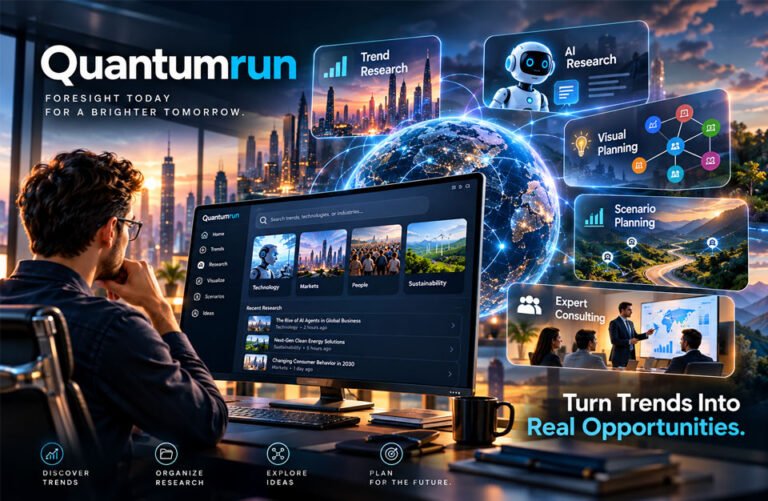
Quantumrun is a strategic foresight and trend research company. It offers a Foresight Platform, AI research tools, trend research, and consulting services.
The platform helps organizations study changes that may affect them in the future. These changes can come from technology, science, markets, customer behavior, laws, and other areas.
People may search for Quantumrun to learn what it is, how it works, and how businesses can use it. This guide explains its main features, Tylo AI, trend research, planning tools, consulting services, business uses, benefits, and limits.
Quantumrun does not promise to tell users exactly what will happen in the future. Instead, it helps organizations study possible changes and use that information to make better plans.
What Is Quantumrun?
Quantumrun is a company that focuses on trend intelligence and strategic foresight.
It helps organizations study changes that could affect their work in the future. These changes may involve technology, science, business, markets, customer habits, or public policy.
Quantumrun mainly offers two types of services.
The first is the Quantumrun Foresight Platform. It helps teams find, save, organize, share, and study trend information.
The second is consulting. Quantumrun can provide professional help to organizations that need deeper research or support with future planning.
The platform can be useful for strategy, research, innovation, product development, and R&D teams. Organizations can use the research to think about future products, services, policies, strategies, and business ideas.
Quantumrun is not a fortune-telling service. It does not say that one future will definitely happen.
Instead, it helps users find signs of possible change and think about what those changes could mean.
For example, a company may study new technology, customer habits, laws, and scientific research. It can then consider how these changes may affect its market in the future.
What Is Strategic Foresight?
Strategic foresight is a way of studying possible future changes so an organization can make better plans today.
It starts by finding signals. A signal is something happening now that may become more important later.
Signals can come from technology, patents, scientific studies, customer habits, industry news, markets, government policies, and new laws.
A signal does not prove that something will happen. It simply gives researchers something worth watching.
For example, many new patents in one area may show growing interest in a technology. A new law may make a product easier or harder to sell. Changing customer habits may create a new business opportunity.
Foresight teams collect these signals and look for patterns.
They can ask questions such as: How important could this change become? When could it matter? Who could it affect? What should the organization do about it?
Strategic foresight also looks at different possible futures instead of depending on one prediction.
For example, a technology may grow quickly. It may grow slowly because it is expensive. Or another technology may replace it.
Studying different possibilities can help organizations make more flexible plans.
How the Quantumrun Foresight Platform Works
The Quantumrun Foresight Platform gives teams one place to manage trend research.
Users can find information, save useful research, organize signals, and work with other team members.
Its basic process can be divided into three parts: research, curate, and visualize.
Research
The first step is finding useful information.
Teams may watch new technologies, patents, scientific discoveries, customer habits, competitors, laws, and changes in other industries.
Quantumrun provides trend research and research feeds to help users find these signals.
It also includes Tylo, an AI research assistant. Tylo can help users research questions and create reports from different types of sources.
Finding information is only the first step. Teams still need to decide which information is useful.
Curate
The next step is organizing the research.
Users can save useful information in lists and organize it for later use. They can also search, sort, import, export, share, and group trend information.
This can solve a common problem for research teams.
One employee may keep reports in browser bookmarks. Another may save documents on a computer. Other information may stay in emails or spreadsheets.
Keeping research in one place makes it easier to find and use again.
Different team members can also collect different types of information. One person may study technology while another follows customer behavior or new laws.
Putting this information together can help teams see useful connections.
Visualize
The final step is making the research easier to understand.
Quantumrun includes visual tools that can help users map trends and compare information.
Teams may compare trends based on timing, risk, market impact, or business value.
Visual tools can also make meetings and workshops easier. Everyone can look at the same information instead of reading many separate reports.
These tools can support market research, strategy planning, scenario planning, and new ideas.
However, the tools do not make the final decision. People still need to check the facts and use their own experience and judgment.
Tylo AI Research Assistant
Tylo is Quantumrun’s AI research assistant.
Users can ask research questions and receive custom reports. These reports may include information and citations from industry sources, patents, and academic research.
Tylo may help teams save time when starting research on a large topic.
For example, a product team could research a new technology. An R&D team could look at patents and scientific studies. A strategy team could study changes that may affect its industry.
AI can make this research faster, but users should still check important information.
A source may not fully support a claim. Important details may also be missing or outdated.
For important business or policy decisions, teams should read important original sources and compare the findings with their own knowledge.
Tylo is best used as a research helper, not as a replacement for researchers or experts.
Trend Scanning and Research Feeds
Trend scanning means looking for early signs of future change.
Quantumrun helps teams do this regularly through trend research and research feeds.
Signals may come from patents, technology news, scientific papers, new laws, customer behavior, industries, or market changes.
For example, a product team may follow patents related to a new technology. A strategy team may watch customer habits and new laws. An R&D team may follow scientific studies that could affect future products.
Custom feeds can help users focus on selected markets, industries, technologies, countries, or topics.
This is different from doing one web search.
A normal search shows what information is available at that time. Ongoing trend scanning helps teams see how a subject changes over time.
An early signal may look small at first. It may become more important when similar developments start appearing.
However, signals are not guarantees.
Some trends grow quickly. Others grow slowly or disappear.
Teams should review their research often and update it when new information becomes available.
Research Organization and Team Collaboration
Research can become difficult to manage when many people are working on the same topic.
One person may collect industry reports. Another may study customers. Someone else may follow competitors or new laws.
If all this information is stored in different places, useful research can be lost or missed.
Quantumrun gives teams a central place to organize their research.
This can also reduce repeated work. Team members can check earlier research before starting another search.
Different departments can also look at the same trend in different ways.
For example, an innovation team may see a new technology as a product opportunity. Finance may focus on its cost. Marketing may look at customer demand. A strategy team may see a possible future risk.
Bringing these views together can help leaders understand the situation better.
Teams still need to keep their research organized. Clear categories, useful notes, regular reviews, and clear responsibilities are important.
Visual Planning and Ideation Tools
Quantumrun also provides tools that help teams turn research into visual information.
These tools can help users compare trends and find connections between them.
For example, a new material may not look very important by itself. But it may become useful when combined with lower costs, new environmental laws, and changing customer needs.
Visual mapping can make these connections easier to see.
The collected information also mentions an Ideation Engine. It is reported to help teams compare trends and explore new ideas.
It may be useful for product ideas, market planning, new services, and business strategy.
However, its exact current features should be checked with Quantumrun because platform features can change.
An ideation tool cannot guarantee that an idea will succeed.
Teams still need to study customer demand, costs, technology, laws, and business goals before moving forward with an idea.
Scenario Planning
Scenario planning means studying several possible futures instead of depending on one prediction.
For example, a company may be studying a new technology.
In one possible future, the technology becomes cheaper and grows quickly. In another, new laws slow its growth. In a third, customers choose a different technology.
Each situation may require a different business plan.
Quantumrun’s foresight tools can support this type of planning.
The collected information also mentions a Scenario Composer. It is reported to help organize trends using information such as time, likelihood, market impact, sector, topic, and location.
Its exact current features should be confirmed through Quantumrun’s official information.
Scenario planning is not about finding one future that will definitely happen.
Its purpose is to see whether a plan can still work under different conditions.
This can help organizations find weak parts of their plans early and prepare other options.
Strategic Planning and Risk Management
Organizations often face many trends at the same time. Not all of them are equally important.
Some changes may affect a business soon. Others may take many years. Some may have a large impact, while others may have little effect.
Strategic foresight can help teams decide which changes need the most attention.
Two useful things to consider are impact and timing.
A major change that may happen soon could require quick action. A major change that is still years away may only need monitoring or small tests for now.
Quantumrun’s research and visual tools can help teams compare these changes.
The collected information also connects Quantumrun with planning methods such as SWOT and VUCA.
SWOT looks at strengths, weaknesses, opportunities, and threats. VUCA is used when discussing situations that are volatile, uncertain, complex, and unclear.
The exact way Quantumrun currently uses these methods should be checked with its official platform information.
Foresight research can also help organizations create longer-term plans. A company may decide which technology to watch, which idea to test, or which risk needs more preparation.
However, no research platform can remove all risk.
Trends can change. New laws can appear. Research may be incomplete. Unexpected events can also change earlier plans.
The final decision still depends on good information and human judgment.
Quantumrun Consulting Services
Quantumrun also provides strategic foresight and innovation consulting.
These services can help organizations that need more support than software alone can provide.
Its consulting work can include trend research, scenario planning, strategy support, and product or service ideas.
For example, a company may have a lot of market information but may not know which changes are most important.
A foresight consultant can help define the main question, find useful signals, compare possible outcomes, and connect the research with business decisions.
Consulting may also help companies that want to enter a new market, create a new product, respond to major industry changes, or study an unfamiliar market.
Other reported services include workshops, custom research, market intelligence, startup scouting, and support for longer-term planning.
Some services may change over time. Organizations should check current options directly with Quantumrun before starting a project.
Business Uses for Quantumrun
Quantumrun can be used for different types of business and organizational research.
Strategy and Leadership Teams
Strategy teams can study changes that may affect a company over the coming years.
They may watch customer demand, costs, new laws, technology, workers, supply chains, and competitors.
This information can help them check whether their current strategy will still work in the future.
Product and Innovation Teams
Product teams can look for new customer needs and market opportunities.
They can connect changes in technology, customer habits, materials, logistics, costs, and laws.
These connections may lead to new product, service, or business ideas.
Research and R&D Teams
Research and development teams can use foresight for technology scouting.
They may watch patents, scientific research, new technologies, and developments in other industries.
This can help them find changes that may affect future products or research.
Market Intelligence and Marketing Teams
Market intelligence teams can study competitors, customers, industries, and wider market changes.
Marketing teams may use trend research to understand changing customer needs and buying habits.
Government and Public-Sector Organizations
Government and public organizations can also use strategic foresight.
They may study social, economic, scientific, technological, and legal changes that could affect future policies.
Scenario planning can help them study how a policy may work under different future conditions.
Academic Users
The collected information says students, teachers, and academic researchers may also use Quantumrun.
Current academic plans, prices, and access rules should be checked directly with Quantumrun.
Practical Examples of Using Quantumrun
A product company could watch patents related to batteries, AI, new materials, or other technologies. This may help the company notice important developments earlier.
A strategy team could study competitors, customer habits, laws, and technology together. Several small signals may point to a larger market change.
A food company could study alternative proteins, water supply, packaging rules, farming technology, and customer preferences.
A healthcare organization could watch remote healthcare, medical technology, staffing problems, AI, patient needs, and data privacy laws.
Government teams could study different possible outcomes before creating a long-term policy.
The main idea is to connect different signals with a real decision. This makes the research more useful.
Quantumrun Pricing and Plans
The collected information suggests that Quantumrun has different options for different users.
Reported options include plans for individual professionals, academic users, teams, and larger organizations.
Features may depend on the plan. These could include research credits, custom feeds, collaboration tools, support, and professional services.
Enterprise access may also include help from a foresight professional.
Exact current prices were not confirmed in the information collected for this article. Plan names, prices, limits, and features may also change.
Readers should check Quantumrun’s current official pricing information before paying for a plan.
Teams should also think about how often they will use the platform. A larger plan may not be useful if the organization does not regularly use its research and planning tools.
If Quantumrun currently offers a demo or trial, testing it with a real research question may help a team decide if it fits their needs.
Benefits of Quantumrun
One benefit of Quantumrun is that it puts several research tasks in one place.
Users can find research, organize it, share it, and use visual tools to study it.
This can reduce the need to use many separate tools.
Keeping research in one place can also make older information easier to find and use again.
Team collaboration is another benefit. Different departments can study the same signals and share their knowledge.
Visual tools can make complex trends easier to understand and compare.
Quantumrun also combines software with consulting. This may help organizations that do not have their own large foresight team.
The main benefit is better preparation. The platform cannot tell users exactly what will happen, but it can help them notice possible changes and think about how to respond.
Limitations and Points to Consider
Quantumrun cannot predict the future with complete accuracy.
A trend that looks important today may slow down later. Another trend may grow faster than expected.
New laws, economic changes, scientific discoveries, or unexpected events can also change earlier assumptions.
Research quality is another important point. AI tools can help users find information faster, but people should still check important sources.
Teams also need a clear research process.
Someone should review old signals, update the research, and make sure useful information reaches the people making decisions.
Cost may also matter.
A company that regularly studies trends may get more value from a specialized platform. A small team that only needs basic research from time to time may not need all of its tools.
Before choosing Quantumrun, organizations should think about who will use it, how often they will use it, and how the research will support real decisions.
Quantumrun vs. Normal Research Tools
A normal search engine and Quantumrun have different purposes.
A search engine helps users find websites, reports, news, and answers.
A news tool helps people follow recent events.
Quantumrun goes further by helping users collect, organize, share, and study research for future planning.
It also focuses on what may happen next.
A normal research question may ask, “What is happening now?” Strategic foresight also asks, “What could happen next, and how could it affect us?”
This makes Quantumrun more like a shared foresight workspace than a normal search engine or news website.
Simple research tools may still be enough for short or basic research tasks.
Quantumrun may be more useful for teams that need regular trend monitoring, shared research, scenario planning, and long-term strategy.
How to Get Better Results From Quantumrun
Start with a clear question.
A very broad question such as “What is the future of transportation?” may produce too much information.
A more focused question could be: “How could battery technology and new laws affect city delivery vehicles by 2032?”
Other useful tips include:
- Choose a clear topic or business question.
- Set a market, country, or time period when needed.
- Save only useful signals.
- Use clear tags, dates, and notes.
- Use different types of sources.
- Check important AI findings against original sources.
- Create more than one future scenario.
- Review research regularly.
- Remove old or weak information.
- Connect the research with a real decision.
At the end of the research, teams should ask what they need to do next.
They may decide to watch a trend, test an idea, study something further, prepare for a risk, or consider an investment.
Is Quantumrun Worth Using?
Quantumrun may be useful for organizations that make long-term decisions.
It can be especially helpful when a team needs to follow many trends or bring research from different areas into one place.
Organizations dealing with fast technology changes, long investment periods, or many outside risks may also benefit from strategic foresight tools.
Quantumrun may be less useful for someone who only wants quick news or simple research.
Regular use is important. Saving reports without using them in planning provides little value.
Whether Quantumrun is worth using depends on the organization’s needs, budget, team size, and planning goals.
It is best understood as a tool that supports decisions rather than one that gives certain answers about the future.
Bottom Line
Quantumrun is a strategic foresight and trend intelligence platform and consulting service.
It helps teams find trends, organize research, use AI-assisted research, create visual views, study possible futures, and support long-term planning.
Its main purpose is to help organizations prepare for change. It does not promise perfect predictions.
Good results still depend on reliable information, clear research questions, regular reviews, and human judgment.
For organizations that regularly study future trends, Quantumrun can provide a structured way to connect research with strategy, innovation, and planning.
Frequently Asked Questions
What is Quantumrun?
Quantumrun is a trend research and future planning company. It offers research tools, software, AI tools, and consulting services.
How does Quantumrun work?
Quantumrun helps users find trends, organize research, and create visual information. Teams can use this information for future planning.
Is Quantumrun an AI platform?
Quantumrun uses AI, but it is not only an AI platform. It also provides trend research, planning, collaboration, and visual tools.
What is Tylo?
Tylo is Quantumrun’s AI research assistant. It helps users research topics and create reports using different sources.
Does Quantumrun predict the future?
No. Quantumrun studies trends and possible future changes. It helps users prepare for different outcomes.
Who is Quantumrun for?
Quantumrun is mainly for research, strategy, innovation, product, R&D, and market teams. Public organizations can also use it.
What can businesses use Quantumrun for?
Businesses can use it to study trends, find new ideas, explore risks, and plan for future changes.
Is Quantumrun worth using?
It can be useful for teams that regularly study trends and make long-term plans. Simple research needs may not require all its tools.
Discover More:
TriDeltathon Complete Guide: Swim, Bike, Run, and Charity History
