


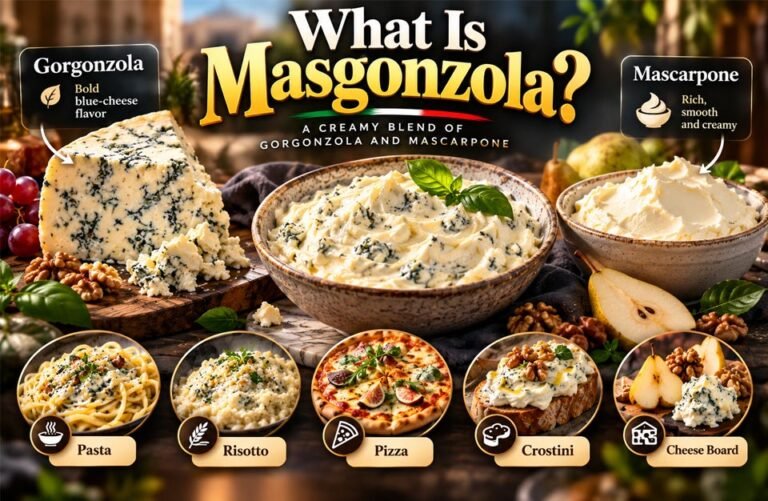
Masgonzola is a creamy cheese made by combining Gorgonzola and mascarpone. Gorgonzola gives it a blue-cheese flavor, while mascarpone makes it softer, creamier, and milder.
People often search for Masgonzola because its name sounds like a separate Italian cheese. However, it is better understood as a mix of Gorgonzola and mascarpone.
This guide explains what Masgonzola is, what it is made from, how it tastes, and how it is used. It also covers nutrition, storage, lactose, and other useful facts.
What Is Masgonzola?
Masgonzola is generally a combination of Gorgonzola and mascarpone.
Gorgonzola gives it a salty, tangy, and slightly earthy blue-cheese taste. Mascarpone adds a mild, buttery flavor and a smooth texture. Together, they create a cheese that is usually softer and milder than Gorgonzola alone.
There is no single recipe for Masgonzola. Some products mix the two cheeses together, while others keep them in separate layers. The amount of each cheese can also be different.
The name Masgonzola may not always appear on the package. Similar products may be called Gorgonzola with Mascarpone, Gorgonzola e Mascarpone, or Gorgonzola-Mascarpone.
Is Masgonzola a Real Cheese?
The food behind Masgonzola is real. Products that combine Gorgonzola and mascarpone are available.
However, Masgonzola is not known as a separate protected cheese variety. It is better described as a cheese specialty made with Gorgonzola and mascarpone.
Gorgonzola itself has Protected Designation of Origin (PDO) status. This means it follows specific production rules and is connected with certain areas of Italy.
No separate PDO or DOP status has been verified for Masgonzola.
Some websites may describe Masgonzola as an old Italian cheese with its own history, region, or aging process. There is not enough reliable information to support these claims.
Where Does the Name Masgonzola Come From?
The name Masgonzola appears to combine mascarpone and Gorgonzola.
“Mas” comes from mascarpone, while “gonzola” comes from Gorgonzola.
Because both are Italian dairy products, Masgonzola can sound like the name of another traditional Italian cheese.
However, there is no reliable information showing exactly who created the name, when it was first used, or where it started.
It is safer to understand Masgonzola as a simple name for a Gorgonzola and mascarpone combination.
What Is Masgonzola Made Of?
Masgonzola has two main ingredients: Gorgonzola and mascarpone.
The amount of each ingredient can change the taste, texture, appearance, and nutrition of the finished cheese.
Gorgonzola
Gorgonzola is an Italian blue cheese made from cow’s milk. It is known for its blue or blue-green veins.
Its flavor can be mild or strong depending on the type and how long it has matured.
In Masgonzola, Gorgonzola provides most of the salty, tangy, earthy, and blue-cheese flavor.
Mascarpone
Mascarpone is soft, smooth, rich, and mild.
It makes Masgonzola creamier and helps reduce the stronger taste of Gorgonzola. This is why Masgonzola is often milder than plain Gorgonzola.
Ingredient Ratios
There is no fixed ratio for Masgonzola.
One commercial product uses 50% Gorgonzola and 50% mascarpone. Another reported product uses 60% mascarpone and 40% Gorgonzola.
More mascarpone usually makes the cheese softer and milder. More Gorgonzola gives it a stronger blue-cheese taste.
Always check the ingredient list if you want to know the exact ratio.
How Is Masgonzola Made?
There is no single official way to make Masgonzola.
Gorgonzola is first made and matured through its own cheesemaking process. It can then be combined with mascarpone.
There are two common ways to combine them.
Blended Masgonzola
Gorgonzola and mascarpone can be mixed together to create a smooth and creamy cheese.
Small blue pieces or veins may still be visible. This type is easy to spread and melts well in warm food.
Layered Masgonzola
The two cheeses can also be placed in separate layers.
For example, Italian producer CasArrigoni has made a product with layers of mild Gorgonzola and mascarpone.
The pale mascarpone can be seen next to the blue-veined Gorgonzola. Each bite may have a slightly different amount of each cheese.
Both blended and layered versions can be found because Masgonzola does not have one official production method.
What Does Masgonzola Taste Like?
Masgonzola usually tastes creamy, buttery, salty, tangy, and slightly earthy.
Gorgonzola provides the stronger blue-cheese taste. Mascarpone makes that flavor softer and smoother.
The taste depends on how much of each cheese is used.
More mascarpone creates a milder taste. More Gorgonzola creates a stronger and more noticeable blue-cheese flavor.
For this reason, Masgonzola may be easier to enjoy for people who find strong blue cheese too sharp.
Masgonzola Texture and Appearance
Masgonzola is usually soft, creamy, moist, and rich.
It is easy to spread on bread and crackers. It also melts easily when added to warm food.
Its appearance depends on how it is prepared.
A layered version can show white or pale mascarpone next to Gorgonzola with blue or blue-green veins. A blended version usually looks more even, although small blue pieces may still be visible.
Masgonzola is firmer when cold. It becomes softer and creamier as it warms.
Masgonzola vs. Gorgonzola
Masgonzola and Gorgonzola are related, but they are not the same.
Gorgonzola is an Italian blue cheese. Masgonzola combines Gorgonzola with mascarpone.
| Feature | Masgonzola | Gorgonzola |
|---|---|---|
| What it is | Gorgonzola and mascarpone specialty | Italian blue cheese |
| PDO/DOP status | No separate status verified | Protected PDO/DOP cheese |
| Texture | Very soft and creamy | Creamy to firmer |
| Flavor | Milder and buttery | Stronger blue-cheese taste |
| Recipe | Can vary | Follows set production rules |
| Aging | No separate aging period | Matured during production |
| Uses | Pasta, sauces, spreads, and risotto | Cooking, sauces, and cheese boards |
Gorgonzola is useful when you want a stronger blue-cheese flavor.
Masgonzola is useful when you want that flavor with a softer and creamier texture.
Some information reports that milder Gorgonzola can mature for about 50 to 150 days, while stronger types can mature for about 80 to 270 days. Masgonzola does not have its own aging period.
Masgonzola vs. Mascarpone
Mascarpone is one of the main ingredients in Masgonzola, but they are different products.
Mascarpone has a mild, creamy, and buttery taste. It does not have the blue-cheese taste of Gorgonzola.
Masgonzola combines the creaminess of mascarpone with the salty and tangy taste of Gorgonzola.
If you cannot find Masgonzola, you can mix Gorgonzola and mascarpone yourself.
Use more mascarpone for a milder taste. Use more Gorgonzola if you want a stronger blue-cheese flavor.
Masgonzola Nutrition and Calories
There is no single nutrition profile for Masgonzola because recipes can be different.
One commercial product made with 50% Gorgonzola and 50% mascarpone provides these values per 100 grams:
| Nutrient | Amount per 100 g |
|---|---|
| Calories | 369 kcal |
| Total fat | 35 g |
| Saturated fat | 23 g |
| Carbohydrates | 1.5 g |
| Protein | 12 g |
| Salt | 0.7 g |
A 30-gram serving of this product has about 111 calories and 10.5 grams of fat.
Another commercial example has different values. It provides about 389 calories, 33 grams of fat, 20 grams of saturated fat, 20 grams of protein, and 0.5 grams of salt per 100 grams.
These are only examples. Always check the nutrition label on the product you buy.
Is Masgonzola Healthy?
Masgonzola provides protein and other nutrients found in dairy foods.
However, it can also contain a high amount of fat, saturated fat, and calories.
Portion size is important. You often do not need a large amount because the cheese has a rich taste.
People who are watching their calories, saturated fat, or salt intake should check the nutrition label before eating it.
It is better to look at Masgonzola as part of your whole diet instead of simply calling it healthy or unhealthy.
Does Masgonzola Contain Lactose?
Masgonzola should not automatically be considered lactose-free.
Gorgonzola PDO can naturally contain very little lactose. However, Masgonzola also contains mascarpone.
The amount of lactose can therefore change depending on the ingredients and recipe.
If you have lactose intolerance, check the product label before eating Masgonzola.
A milk allergy is different from lactose intolerance. Masgonzola contains dairy and milk proteins, so having little lactose does not make it safe for someone with a milk allergy.
How to Use Masgonzola in Cooking
Masgonzola can be used in many hot and cold dishes. It adds creaminess and blue-cheese flavor at the same time.
Because it is rich, you may only need a small amount.
Pasta
Masgonzola can be melted into hot pasta to make a creamy sauce.
Adding a little pasta water can make the sauce smoother and help it cover the pasta.
It can work with gnocchi, ravioli, penne, pappardelle, and other pasta. Mushrooms, spinach, walnuts, pear, and black pepper can also pair well with it.
Risotto
Masgonzola can be added near the end of cooking risotto.
It melts into the rice and adds a creamy texture and blue-cheese flavor.
One documented recipe uses 200 grams of Masgonzola instead of adding Gorgonzola and mascarpone separately.
Pizza and Flatbread
Small pieces of Masgonzola can be added to pizza or flatbread.
It can work well with mushrooms, onions, pumpkin, pear, and walnuts.
The cheese becomes soft and creamy as it heats.
Bread, Crostini, and Crackers
Masgonzola is soft enough to spread directly on bread, crostini, or crackers.
It can also be served with honey, pear, or figs. Their sweetness helps balance the salty cheese.
Appetizers and Cheese Boards
Masgonzola can be served on a cheese board with fruit, nuts, bread, and crackers.
It can also be used as a filling for dates. One documented recipe combines it with a little milk and serves the filled dates with walnuts and arugula.
What Foods Go Well With Masgonzola?
Masgonzola works with both sweet and savory foods.
Fruits such as pears, apples, figs, grapes, and dates add sweetness that balances the salty and tangy cheese.
Honey is another simple pairing. It can be added when Masgonzola is served on bread, crackers, or a cheese board.
Walnuts and hazelnuts add crunch. Mushrooms provide an earthy taste that works well with blue cheese.
Other useful pairings include pumpkin, caramelized onions, arugula, fresh herbs, bread, and crackers.
The best pairing can depend on how strong the Gorgonzola flavor is in the product.
How to Buy Masgonzola
You may not always find this cheese under the exact name Masgonzola.
Look for names such as:
- Gorgonzola with Mascarpone
- Gorgonzola e Mascarpone
- Gorgonzola-Mascarpone
- Gorgonzola and Mascarpone
You may find these products in refrigerated cheese sections, Italian cheese sections, or specialty food stores.
Read the ingredient list before buying.
More mascarpone usually means a softer and milder cheese. More Gorgonzola usually means a stronger blue-cheese taste.
Also check the nutrition information, allergens, use-by date, lactose information, and storage instructions.
If you specifically want Gorgonzola PDO, check the package instead of assuming that every Masgonzola product uses it.
How to Store Masgonzola
Masgonzola should be kept in the refrigerator.
One documented product recommends storing it at 5°C or below. However, different products may have different instructions. Always follow the directions on the package.
Keep the cheese covered after opening. This helps stop it from drying out and can prevent its smell from spreading to other foods.
There is no single shelf life for every Masgonzola product. Follow the use-by date and any instructions about how long it can be kept after opening.
Blue or blue-green veins are normal because Masgonzola contains Gorgonzola. They do not automatically mean the cheese has gone bad.
Do not eat the cheese if you notice unusual changes in its smell, appearance, or texture that suggest it has spoiled.
Common Misunderstandings About Masgonzola
There is some confusing information about Masgonzola online.
One common claim is that Masgonzola is an old Italian cheese with its own region and traditional production method. Reliable information collected for this article does not support that claim.
It is better understood as a cheese specialty made with Gorgonzola and mascarpone.
There is also no single Masgonzola recipe. Some products use equal amounts of the two cheeses, while others use different amounts.
Some products are blended, while others are layered.
Masgonzola also does not have its own fixed aging period. The Gorgonzola is already matured before it is combined with mascarpone.
It should not automatically be called lactose-free either.
The best way to understand a Masgonzola product is to read its ingredient list and package information.
Bottom Line
Masgonzola is generally a creamy combination of Gorgonzola and mascarpone.
Gorgonzola gives it a salty, tangy, and blue-cheese taste. Mascarpone makes it softer, richer, and milder.
Masgonzola is not known as a separate protected Italian cheese. There is also no single recipe that every producer follows.
Products can have different ingredient ratios and may be blended or layered. This can change their taste, texture, nutrition, and lactose content.
Masgonzola can be used in pasta, risotto, pizza, sauces, bread, appetizers, and cheese boards. Always check the product label if you want to know its exact ingredients, nutrition, or storage needs.
Frequently Asked Questions
What is Masgonzola?
Masgonzola is a creamy mix of Gorgonzola and mascarpone. It is softer and milder than regular Gorgonzola.
Is Masgonzola a real cheese?
Yes, the cheese mix is real. However, Masgonzola is not a separate protected cheese variety.
What does Masgonzola taste like?
Masgonzola tastes creamy, buttery, salty, and slightly tangy. Its flavor is usually mild.
Is Masgonzola the same as Gorgonzola?
No. Gorgonzola is a blue cheese, while Masgonzola combines Gorgonzola with mascarpone.
What is Masgonzola used for?
Masgonzola can be used in pasta, pizza, risotto, sauces, sandwiches, appetizers, and cheese boards.
Is Masgonzola lactose-free?
Not always. Check the product label for lactose information before eating it.
What can I use instead of Masgonzola?
You can mix Gorgonzola with mascarpone. Use more mascarpone if you want a milder taste.
How should Masgonzola be stored?
Keep Masgonzola covered in the refrigerator. Follow the storage instructions and use-by date on the package.
Discover More:
