


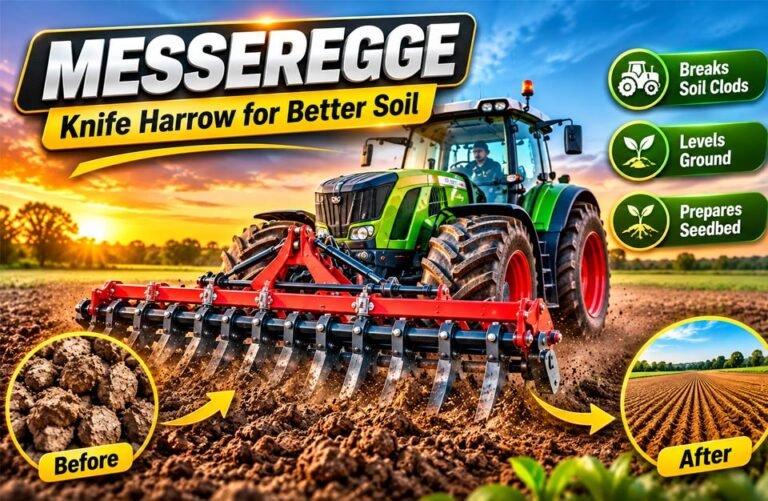
A Messeregge is a farm tool used to prepare soil before planting. It uses steel blades to break large soil lumps, level rough ground, and make the soil easier to work with.
It is often fitted to the front of a tractor. Farmers can use it with a roller, packer, cultivator, seed drill, or other farm equipment.
Messeregge is a German word, so many English readers may not know what it means. There is also some wrong information about it online. This guide explains what a Messeregge is, how it works, its uses, benefits, limits, maintenance, and safety.
What Is a Messeregge?
A Messeregge is a type of farm harrow. It has steel blades that work through the top layer of soil. The blades break large soil lumps and help make rough ground more level.
The word comes from German. Messer means “knife” or “blade,” while Egge means “harrow.”
In English, Messeregge can be called a knife harrow or blade harrow. The German-English dictionary Langenscheidt also translates it as scarifier. However, knife harrow or blade harrow makes its design easier to understand.
Another related word is Messervoregge. This usually means a knife harrow that works in front of another farm tool. For example, it may work before a front packer. The blades break the rough soil first, and the packer then presses and firms it.
A Messeregge is not made for deep soil work. It mainly works near the surface.
Some websites describe Messeregge as a food, digital platform, or design idea. However, farming dictionaries and farm equipment documents support its meaning as an agricultural tool.
Main Parts of a Messeregge
The design can be different depending on the model and company. However, most Messeregge tools have a strong frame, steel blades, mounting points, and adjustment parts.
The steel frame holds the blades in place. It needs to be strong because the blades can hit hard soil and large clods.
The steel blades are the main working parts. They are placed across the frame and work against the soil as the tractor moves.
Blade shape, position, spacing, and angle can affect how the machine works.
Some machines have rigid blades. Other designs may use spring-mounted blades that can move when they hit hard ground or stones.
The mounting system connects the Messeregge to the tractor or another machine. Many models are fitted to the front of a tractor or used with a front packer.
Some machines also let the farmer change the blade height, depth, or angle. These settings control how strongly the blades work the soil.
How Does a Messeregge Work?
A Messeregge works as the tractor moves across a field. Its steel blades touch the upper layer of soil.
The blades hit large soil clods and help break them into smaller pieces. They can also move loose soil into small low areas and reduce rough spots.
A roller or packer can then work behind the blades. It presses the loose soil and can break smaller clods that are still left.
This means the Messeregge does the first part of the soil preparation. Another farm tool can then finish the work.
It is mainly used for surface work. It is not normally used for deep cultivation.
Working Depth and Adjustment
A Messeregge usually works at a shallow depth.
One source gives a working depth of around 1 to 5 cm. However, this is not the correct depth for every machine. The right depth depends on the model, soil, and field conditions.
A shallow setting may be enough to break surface clods. A deeper setting moves more soil and may require more tractor power.
Blade angle can also change how strongly the machine works.
The machine should be level across its full width. If one side is lower, it may work deeper than the other side.
Farmers can make a short test pass before working the full field. They can then check the soil and change the settings if needed.
The instructions for the exact machine should always be followed.
What Is a Messeregge Used For?
A Messeregge is mainly used to prepare rough soil before planting or before another farm machine works the field.
Breaking Large Soil Clods
One of its main jobs is breaking large soil clods.
After plowing, some fields can have large and hard pieces of soil. Clay and other heavy soils can form especially hard clods when they dry.
The blades of a Messeregge hit these clods first and break them into smaller pieces.
A roller, packer, or another machine can then work the soil more easily.
Leveling Rough Ground
A field may have small ridges, holes, and uneven areas after plowing.
The blades help move loose soil and make the surface more even.
A level surface can make planting easier. It can also help a seed drill keep a more even planting depth.
Preparing a Seedbed
A Messeregge can help prepare a seedbed.
A good seedbed should normally have an even surface and manageable soil pieces. The soil also needs enough firmness around and below the seeds.
The Messeregge breaks large clods and levels the top layer. A roller or packer can then press the soil.
The goal is not to turn the soil into very fine dust. The best result depends on soil type, moisture, crop needs, and other equipment.
A Messeregge can help create better planting conditions, but it cannot guarantee good seed growth. Weather, water, seed quality, planting depth, and other factors also matter.
Preparing Soil for Other Implements
A Messeregge can work before other farm equipment.
For example, it may break large clods before a cultivator, power harrow, roller, or seed drill reaches the same ground.
This gives the rear machine a smoother surface to work on.
Why Is a Messeregge Often Mounted at the Front?
A Messeregge is often fitted to the front of a tractor.
This allows it to work the soil before the tractor’s rear wheels and rear equipment pass over the ground.
It also allows farmers to use another machine behind the tractor at the same time.
For example, the Messeregge can break clods at the front while a cultivator works at the back. A seed drill may also be used behind the tractor in some setups.
This can allow several jobs to be completed in one field pass.
Front equipment can also help balance a tractor that has heavy equipment at the back. However, farmers must check tractor weight, axle limits, steering, visibility, and other safety requirements.
Common Messeregge Combinations
A Messeregge is often used with other farm equipment.
Messeregge and Front Packer
This is a common combination.
The Messeregge blades break large clods first. The packer then presses the soil and helps break smaller pieces.
This setup can be useful when the field needs both clod breaking and soil firming.
Messeregge and Roller
A roller can also work after the blades.
The Messeregge breaks and levels the soil. The roller then presses it.
Different rollers work differently, so farmers should choose one that suits their soil.
Messeregge and Seed Drill
A Messeregge can work at the front while a seed drill works behind the tractor.
The front tool prepares rough soil before the seed drill reaches it.
This may reduce the need for another field pass when soil conditions are suitable.
Messeregge and Power Harrow or Cultivator
A power harrow or cultivator can also work behind a Messeregge.
The Messeregge breaks larger surface clods first. The rear machine then completes more detailed soil preparation.
A power harrow is stronger and performs more intensive soil work. A Messeregge does not replace it. The two tools simply perform different jobs.
Best Soil Conditions for a Messeregge
A Messeregge can work on different soil types. However, soil type and moisture can greatly affect the results.
Medium and heavy soils can benefit when they contain large clods.
Clay soil can form large, hard lumps after plowing. A Messeregge can help break these lumps before another machine works the soil.
Loam soil may also benefit when the surface is rough or uneven.
Light sandy soil usually has fewer hard clods. A lighter harrow or roller may be enough in these conditions.
Very wet soil can stick to the blades. It may also become pressed or smeared instead of breaking into useful pieces.
Very dry and hard soil can also be difficult. Hard clods may not break easily and can cause more blade wear.
Large amounts of straw and plant material can also collect around the blades.
Farmers should therefore check the field before starting. The machine should break and level the soil without moving too much soil or causing blockages.
Benefits of Using a Messeregge
A Messeregge can make soil preparation easier when a field has large clods or rough ground.
Breaking the clods creates a smoother surface. This can help a cultivator, roller, packer, or seed drill work more evenly.
A front-mounted Messeregge can also work while another machine is being used behind the tractor.
This may reduce the number of trips needed across the field. Fewer passes may save time, fuel, and machine use.
The tool also works mainly near the surface. This can be useful when deep cultivation is not needed.
However, these benefits depend on the soil, tractor, equipment, and machine settings.
Limitations and Drawbacks
A Messeregge does not work well in every situation.
It mainly works near the surface. It cannot replace a plough, subsoiler, or deep cultivator when deeper soil work is needed.
Very wet soil can stick to the blades. It may also become compacted or smeared.
Very dry soil can have hard clods that are difficult to break. This may also increase blade wear.
Stones can damage the working parts. Large amounts of straw or crop remains can also become trapped around the blades.
Incorrect settings can create poor results. Working too deeply can move too much soil and place more load on the tractor.
Driving too fast can also make the machine bounce and leave an uneven surface.
Front-mounted equipment adds extra weight to the tractor. Farmers must check weight limits, axle loads, steering, tyres, and transport safety.
Messeregge vs Other Harrows
A Messeregge is different from other soil-working tools because it mainly uses steel knife-like blades.
| Tool | Working Parts | Main Use |
|---|---|---|
| Messeregge | Steel blades | Breaking clods and leveling soil |
| Tine harrow | Flexible metal teeth | Light loosening and leveling |
| Disc harrow | Round steel discs | Cutting and mixing soil |
| Chain harrow | Flexible chains | Light surface work |
| Power harrow | Powered tines | Strong seedbed preparation |
| Roller/front packer | Rings, bars, or drums | Pressing and firming soil |
A tine harrow uses flexible teeth. It scratches and loosens the top layer of soil.
A disc harrow uses round steel discs. It can cut and mix soil and plant material. Many disc harrows also work deeper than a Messeregge.
A power harrow uses powered working parts. It provides stronger and more intensive soil preparation.
A roller or packer mainly presses and firms the soil instead of cutting it with blades.
Each tool has a different purpose. The best choice depends on the field and the work that needs to be done.
How to Choose the Right Messeregge
The Messeregge should match the tractor, soil, and other equipment.
First, check the working width. The front tool should work well with the width of the equipment behind the tractor.
Check the tractor’s mounting system and lifting capacity. The tractor must be able to safely carry the machine.
Blade design is also important. Check the blade shape, strength, spacing, and how easy the blades are to replace.
Look for useful adjustments. Some machines allow changes to blade height, depth, and angle.
If the Messeregge is used with a roller or packer, make sure that equipment also suits the soil.
Replacement parts are important. Check whether new blades and other parts are easy to buy.
Also consider machine weight, transport size, repair support, hydraulic needs, and maintenance costs.
There is no reliable standard price for a Messeregge. Prices can change based on the manufacturer, model, size, condition, and country.
How to Use a Messeregge Properly
Check the field and machine before starting.
Look at soil moisture, clod size, and crop remains. Very wet or extremely hard soil may need another type of preparation.
Check the blades, frame, bolts, mounting points, and adjustment parts.
Start with a shallow or gentle setting.
Make a short test pass and then check the soil.
Look for large clods, rough areas, too much loose soil, or signs that the machine is working too deeply.
Change the settings if needed.
Use a steady tractor speed. Driving too fast may make the machine bounce.
If another machine is working behind the tractor, check its results too.
Always follow the instructions provided for the exact machine.
Messeregge Safety
A Messeregge has sharp steel blades and is connected to heavy farm machinery.
Keep people away while the machine is working.
Never touch the blades or remove trapped soil while the equipment is moving.
Before cleaning or checking the machine, park the tractor safely and lower the equipment as instructed. Stop the engine and secure the machine.
Hydraulic systems can remain under pressure. Follow the manufacturer’s instructions before working on hydraulic parts.
Check bolts, mounting points, lights, and warning equipment when required.
Front equipment can also change how the tractor handles. Check axle loads, steering, visibility, tyre limits, machine width, and total weight.
Always follow the safety instructions for both the tractor and Messeregge.
Maintenance and Common Problems
Regular care can help a Messeregge work properly and last longer.
Blade Wear and Damage
Blades slowly wear because they work directly against soil and stones.
Check for worn edges, cracks, bends, and other damage.
Uneven blade wear can make one part of the machine work deeper than another.
Replace badly worn or damaged blades when needed.
Uneven Soil Finish
If the machine leaves some areas rough, check its settings.
Make sure both sides are set evenly. Also check for worn blades.
Soil moisture and tractor speed can also cause uneven results.
Residue or Soil Buildup
Wet soil, straw, and plant material can collect around the blades.
This can stop the machine from working correctly.
Stop and secure the tractor before removing any blockage.
Bolts, Frame, and Linkage
Farm work creates vibration and pressure.
Check bolts, mounting points, the frame, and adjustment parts regularly.
Look for loose parts, cracks, bends, or other damage.
Cleaning, Lubrication, and Storage
Clean soil and plant material from the machine after use.
Lubricate the parts listed in the manufacturer’s instructions.
Keep hydraulic connections clean if the machine uses hydraulics.
Store the equipment on firm ground in a safe place. Keeping it under cover can help protect it from rust and weather.
Messeregge Manufacturers and Equipment Examples
Several farm equipment companies are connected with Messeregge or similar front-harrow systems.
Kerner has documented Messeregge equipment for use with front packers. Its systems include steel knives and adjustment options. Kerner also offers other front-harrow options for some equipment.
Fliegl has also offered front-mounted Messeregge equipment. One reported example is a 3-meter Messeregge designed for the company’s Profiwalze 3000.
Rotoland has been mentioned in connection with front packers fitted with a Messervoregge. Reported sizes include 2.5-meter and 3-meter working widths.
These are examples only. Models and availability can change. Farmers should check current specifications with the manufacturer or equipment dealer.
Is a Messeregge Worth Using?
A Messeregge can be useful for farms that often have rough soil and large clods after plowing.
It can be especially useful when farmers want to use equipment at both the front and back of the tractor.
This may allow several jobs to be completed in one pass.
Medium and heavy soils with large clods may benefit more than light soil.
However, every farm does not need a Messeregge. A lighter harrow or roller may be enough when the soil is already easy to work.
The choice depends on soil type, tractor size, crops, field conditions, existing equipment, and cost.
Why Is There Confusing Information About Messeregge Online?
Some websites give very different meanings for the word Messeregge.
They may describe it as a food, digital platform, design idea, or something else.
However, the information collected for this article does not provide strong evidence for these meanings.
The agricultural meaning has much better support. Farming dictionaries, machinery documents, parts information, and equipment descriptions identify Messeregge as a farm tool.
The confusion may exist because Messeregge is a specialized German word that is not well known among English speakers.
Based on the available evidence, knife harrow or blade harrow is the clearest meaning of Messeregge.
Bottom Line
A Messeregge is a German farm tool used for shallow soil preparation. Its steel blades break large soil clods and help level rough ground.
It is often fitted to the front of a tractor and used with a roller, packer, cultivator, power harrow, or seed drill.
The tool can help farmers prepare soil and may reduce separate field passes. However, good results depend on the soil, tractor, machine setup, and correct adjustment.
Frequently Asked Questions
What is a Messeregge?
A Messeregge is a farm tool with steel blades. It breaks soil lumps and makes the ground more level.
What does Messeregge mean in English?
Messeregge means knife harrow or blade harrow. Messer means knife, and Egge means harrow.
What is a Messeregge used for?
It is used to break large soil clods, level rough ground, and prepare soil for planting.
How does a Messeregge work?
Its steel blades move through the top layer of soil. They break large clods and make the surface smoother.
How deep does a Messeregge work?
It works mainly near the soil surface. Some machines may work around 1 to 5 cm deep, depending on the model and soil.
What is the difference between a Messeregge and a tine harrow?
A Messeregge uses steel blades to break soil clods. A tine harrow uses flexible teeth to loosen and level the soil.
Can a Messeregge fit any tractor?
No. The tractor must have the right mounting system and enough power and lifting capacity for the machine.
Can a Messeregge reduce fuel use and field passes?
Yes, it may reduce extra field passes by working with other farm equipment. This can save time and fuel in suitable conditions.
Discover More:
Supermaked Guide: Digital Shopping, Smart Retail, and Key Facts
