


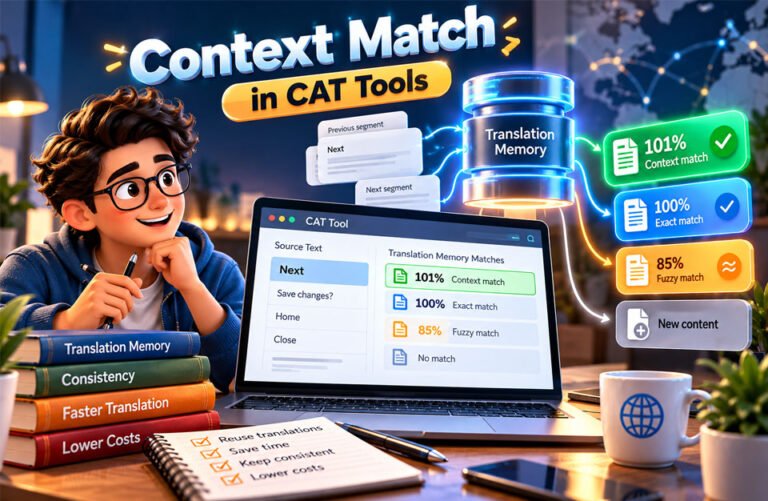
A context match is a strong match found in computer-assisted translation (CAT) tools. It happens when new source text is the same as text stored in a translation memory, and its context also matches.
You may see terms such as 101% match, ICE match, or other match scores in translation software. These terms can be confusing because a 100% match already sounds complete.
The main difference is context. A CAT tool can check the text around a segment, its ID, file structure, or other saved details. This helps translators know if an old translation fits the new content.
This guide explains what a context match is, how it works, how it differs from other matches, and why it is useful.
What Is a Context Match?
A context match happens when the current source text is the same as text stored in a translation memory and its required context also matches.
For example, the word “Next” may appear on a registration screen. If it later appears in the same place with the same surrounding information, the CAT tool has more reason to reuse the old translation.
Context can include the text before or after a segment. It may also include an ID, tag, file position, or document structure.
This makes a context match stronger than a normal exact match. The tool knows that both the words and their use are the same or closely connected.
However, a context match does not prove that an old translation is correct. If the translation memory contains a mistake or an old term, that problem may also appear in the new project.
Different CAT tools may also use different rules to decide what counts as matching context.
What Is Translation Memory?
A Translation Memory (TM) is a database that stores text that has already been translated.
It normally saves the original text and its translation together. These saved pieces of text are called segments.
A segment can be a sentence, heading, button, menu item, warning, label, or another short piece of text.
For example:
Source: “Confirm your order.”
Translation: The translated version in another language.
When the same or similar source text appears again, the CAT tool searches the translation memory and suggests the old translation.
This saves time because translators do not have to translate the same content again.
Translation memory is useful for websites, apps, manuals, product information, and other content that is updated often.
The quality of the TM is important. If it contains good translations, it can save a lot of work. If it contains mistakes or old terms, those problems may also be reused.
How Does a Context Match Work?
When a translator adds a file to a CAT tool, the software usually divides the content into smaller parts called segments.
The tool compares each segment with text stored in its translation memory.
First, it checks whether the source text is the same.
If an exact match is found, the tool may then check its context. It looks at available information about where and how the segment is being used.
If both the source text and required context match, the tool may show it as a context match.
This allows translators to quickly find and reuse work from older projects.
What Context Can a CAT Tool Check?
A CAT tool may check the text before and after a segment. If the same sentence appears between the same surrounding sentences, this gives the tool more information about its use.
Some tools can also use segment or string IDs. These IDs can help identify a specific button, message, field, or other part of software.
Other context can include:
- Segment position
- Document information
- File information
- Tags
- File structure
- Structural data
- CMS identifiers
Not every CAT tool checks all these details. The available context also depends on the type of file being translated.
Why Context Matters in Translation
The same word can have different meanings in different places.
For example, “Home” on a website may mean the main page. In another sentence, it may mean a person’s house. On a phone or computer, it could mean the home screen.
The word is the same, but its meaning depends on where it appears.
Words such as “Open,” “Close,” “Next,” and “Continue” can cause the same problem.
This is especially important for short text such as buttons, menus, alerts, headings, and labels. A one-word button gives a translator very little information.
Context helps show what the word means and how it is being used.
It can also help with grammar. Some languages change words based on gender, formality, grammatical case, or nearby sentences.
For this reason, an exact text match is not always enough.
Context Match vs. 100% Match
A 100% match normally means the current source text is exactly the same as text stored in the translation memory.
A context match goes one step further. The source text is the same, and the required context also matches.
For example, “Save changes?” may appear in several parts of an app. It could appear in profile settings or on a payment page.
The English words are the same, so the CAT tool may find a 100% match. However, their use may be different.
A context match gives the tool more information that the old translation belongs in the same type of place.
| Context Match | 100% Match |
|---|---|
| Source text is the same | Source text is the same |
| Context also matches | Context may be different |
| Gives more information about the use | Mainly confirms the same text |
| May need less review | May need a context check |
A context match can still need review. This depends on the project, language, content, and quality of the translation memory.
Context Match vs. Fuzzy Match
A fuzzy match means the new source text is similar to old text, but it is not exactly the same.
A number, product name, word, or punctuation mark may have changed.
For example:
Old: “Your order will arrive in 3 days.”
New: “Your order will arrive in 5 days.”
Most of the sentence is the same, but the number has changed. The translator needs to notice and translate that change correctly.
Fuzzy matches can save time because translators can edit an older translation instead of starting again.
However, they usually need more work than a context match.
Simple Match Comparison
| Match Type | Source Text | Context | Work Needed |
|---|---|---|---|
| Context match | Exact | Matches | Often less review |
| 100% match | Exact | May differ | May need checking |
| Fuzzy match | Similar | May differ | Usually needs editing |
| New content | No useful match | — | Usually needs full translation |
The exact match percentages and rules can be different in each CAT tool.
What Does a 101% Match Mean?
A context match is sometimes called a 101% match.
This does not mean the translation is literally 101% accurate. The number is simply used to show that the tool found more than a normal exact match.
The basic idea is:
100% match: The source text matches.
101% match: The source text and required context match.
The extra context can make the stored translation more useful and reliable.
However, not every CAT tool uses the term 101% in the same way. Some tools use different names, scores, or rules.
Always check how your translation software defines its match scores.
What Is an ICE Match?
ICE usually means In-Context Exact.
An ICE match is an exact text match where the required context also matches.
Some translation teams may treat these matches as trusted content. They may pretranslate them, review them less, skip them during some steps, or lock them.
However, an ICE match can still contain an old mistake.
Important content, such as legal text, safety warnings, health information, or payment details, may still need human review.
The exact meaning of ICE can also depend on the translation software being used.
Perfect Match and Other Tool-Specific Terms
Different CAT tools use different names for strong matches.
Some translation software uses terms such as Perfect Match. These features may check the source text, nearby segments, document structure, or information from an older translated file.
This can be useful when updating manuals, reports, and product documents. Most of the old document may stay the same while only a few parts change.
However, Perfect Match should not always be treated as another name for context match. Its exact meaning depends on the software.
102% or Double Contextual Matches
Some CAT tools can check more than one type of context.
For example, a tool may check both nearby text and a unique ID. When both match, the software has even more information about the segment.
Some memoQ workflows use terms linked with double contextual matching, including product-specific scores or labels such as 102% or XLT.
This can be useful for XML files, software text, and content from a CMS where stable IDs are available.
These terms are specific to certain software. Always check the CAT tool’s own documentation to understand what each score means.
Where Context Matches Are Most Useful
Context matches work best with content that is repeated and has a clear structure.
Software and App Localization
Apps often reuse buttons, menus, settings, tooltips, alerts, and error messages.
Stable IDs can help a CAT tool understand which part of the software each string belongs to.
Websites and E-Commerce
Websites can reuse navigation text, forms, account messages, checkout instructions, shipping details, and return information.
Context matches can be useful when a website is updated but keeps the same basic structure.
Technical Documentation
Product manuals often share instructions between different models or versions.
A CAT tool can reuse older translations while translators focus on the sections that have changed.
Legal and Financial Content
Legal and financial documents may reuse standard clauses, notices, and terms.
Context matching can help keep this language consistent. However, human review is still important because rules or requirements may change.
Forms, Catalogs, Training, and Support Content
Forms, catalogs, training guides, and support documents often contain repeated text.
Context matching works well when this content keeps a stable structure.
It is usually less useful for creative writing or documents that change structure often.
Benefits of Context Matches
Context matches can make translation work faster and more consistent.
Faster Translation
Translators can reuse work that has already been completed.
They can spend more time on new text and sections that actually changed.
Better Consistency
The same approved words can be used across different versions of a product.
This helps keep product names, buttons, warnings, and other important text consistent.
Less Repetitive Work
Translators do not have to translate or check the same content again and again.
This allows them to focus on more difficult or new text.
Better Project Planning
Project managers can see how much content is new, fuzzy, exact, or already available as a context match.
This helps them estimate the time and work needed.
Potential Cost Savings
Context matches may cost less to process because the text has already been translated.
The amount saved depends on the project and pricing agreement.
How Context Matches Affect Translation Pricing
Translation companies may charge different rates based on the type of match.
New text usually receives the full translation rate.
Fuzzy matches may receive a discount because some of the old translation can be reused.
Exact matches may cost less. Context matches may receive an even bigger discount if they need very little work.
However, a 101% match is not always free.
Projects may still need file preparation, review, testing, quality checks, and project management.
Pricing can also depend on the language, subject, CAT tool, client requirements, and translation memory quality.
There is no standard price for a context match. The client and translation provider should agree on pricing before the project starts.
Can a Context Match Still Be Wrong?
Yes. A context match can still be wrong.
The CAT tool checks whether the text and context match old information. It does not always know whether the old translation itself is correct.
For example, an old translation memory may contain a wrong product term. If that same text appears again, the tool may reuse the mistake.
Old translations can also become outdated. A company may change its product, terminology, legal wording, or writing style.
A high match score is therefore useful, but it does not guarantee quality.
When Context Matches Still Need Human Review
Some context matches need more careful review than others.
Safety warnings should be checked because mistakes may affect how a product is used.
Legal, financial, health, and payment information may also need careful review.
Human review can also be useful when a company changes its brand language, style guide, products, or important terms.
Some languages need more context because words can change based on gender, case, formality, or nearby sentences.
A human translator should still decide whether the suggested translation works correctly in the current situation.
Common Problems With Context Matching
Missing or Incomplete Context
Sometimes the CAT tool does not have enough information about a segment.
Solution: Keep useful nearby text, IDs, tags, and other context when possible.
Ambiguous Short Strings
Short words such as “Open,” “Close,” and “Next” can have several meanings.
Solution: Give translators useful descriptions, screenshots, IDs, or other reference information.
Poor Translation Memory
A TM may contain mistakes, duplicate entries, old terms, or inconsistent translations.
Solution: Clean the translation memory regularly and correct known problems.
Changed Segment Order or Structure
Changing a document’s structure can break useful context even when the text stays the same.
Solution: Keep templates and document structure stable when possible.
Missing or Rebuilt IDs
Changing software or CMS IDs can remove useful context.
Solution: Keep IDs stable unless there is a real reason to change them.
File Conversion Removes Metadata
Changing file formats may remove IDs, tags, or other useful information.
Solution: Check that important metadata stays in the file during conversion.
Different CAT Tools Use Different Rules
Match labels and scores can mean different things in different tools.
Solution: Check the documentation and settings of the CAT tool you are using.
Overreliance on Match Scores
A high score does not prove that the translation is correct.
Solution: Use human review and good translation quality rules along with match scores.
Locked Matches Cannot Be Corrected
Some workflows lock trusted matches so translators cannot change them.
Solution: Have a clear way for translators to report and correct wrong locked segments.
How to Improve Context Match Quality
Start with a clean translation memory.
Correct known mistakes and review old or duplicate entries. Remove translations that should no longer be used.
Keep IDs, tags, templates, and document structure stable when possible. This gives the CAT tool more useful context.
Use consistent source language as well. Writing the same idea in the same way can help translation memory find more useful matches.
Teams should also track changes between different versions of a document.
Regular TM maintenance is important because products, terminology, and company language can change over time.
Use a Termbase and Style Guide
A termbase is different from a translation memory.
A translation memory mainly stores translated segments. A termbase stores approved words and terms.
For example, a company can use a termbase to make sure an important product or technical term is translated in the same way.
A style guide gives translators rules about tone, capitalization, punctuation, formality, and preferred wording.
Using a translation memory, termbase, and style guide together can improve consistency and translation quality.
Context Match Beyond CAT Tools
The term context match can also have a wider meaning outside translation software.
In education, context can help students understand the meaning of a word by looking at the sentence or passage around it.
Search engines use context and meaning to better understand what a person is searching for.
In SEO and content writing, content should match the topic and the reason behind a person’s search instead of simply repeating keywords.
Artificial intelligence can also use earlier messages, documents, and other available information to understand what a user means.
The general idea is simple: information should be understood together with the situation around it.
However, these wider meanings are different from the more technical meaning used in CAT tools.
Bottom Line
A context match helps a CAT tool find old translated text that appears in the same or matching context.
A normal 100% match tells the translator that the source text is the same. A context match also checks useful information around that text.
This can save time, improve consistency, reduce repeated work, and sometimes lower translation costs.
However, a context match does not guarantee that the old translation is correct. Good translation memory, clear context, and human review are still important.
Frequently Asked Questions
What is a context match in simple words?
A context match means the text and its surrounding context match an old translation. This helps the CAT tool reuse the right translation.
Is a context match the same as a 100% match?
No. A 100% match checks the exact text. A context match checks both the text and its context.
Why is a context match called a 101% match?
Some CAT tools use 101% when both the text and context match. It does not mean the translation is 101% accurate.
What is the difference between a context match and a fuzzy match?
A context match uses exact text with matching context. A fuzzy match finds text that is similar but not exactly the same.
What does ICE match mean?
ICE means In-Context Exact. It means both the exact text and its required context match.
Can a 101% context match be wrong?
Yes. The old translation may have a mistake or outdated words, so it may still need checking.
Do translators review context matches?
Sometimes. Important content, such as legal, health, safety, or financial text, may need human review.
Do context matches reduce translation costs?
Yes, they can. Reusing old translations can reduce work and may lower the translation cost.
Discover More:
Lucipara Banda Sea: Islands, Marine Life, Fishing, and Travel Tips
