


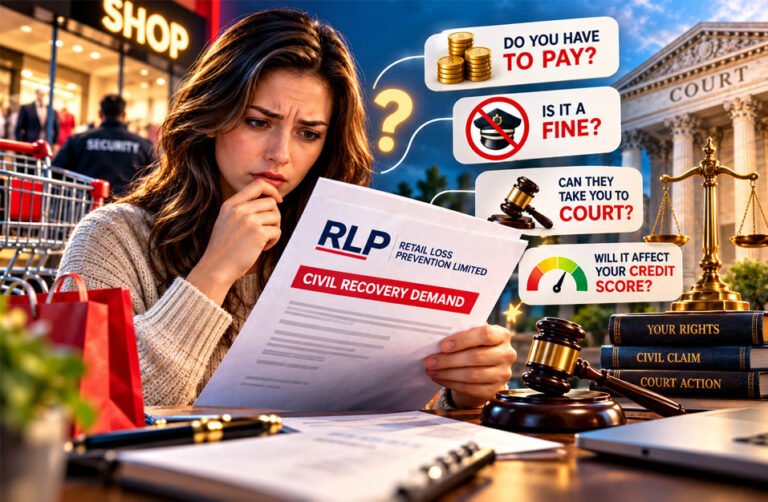
An RLP letter is usually a civil recovery letter linked to Retail Loss Prevention Limited. You may receive one after alleged shoplifting, theft, employee theft, fraud, or another incident where a retailer says it lost money.
People often want to know if an RLP letter is a fine, whether they have to pay it, and whether it can lead to court action.
This guide explains what an RLP letter is, why it may be sent, what a retailer can claim, and what you can do after receiving one.
What Is an RLP Letter?
An RLP letter is usually a request for money sent by Retail Loss Prevention Limited for a retailer or another business.
Retail Loss Prevention Limited is a private UK company. It was incorporated on 18 June 2003 under company number 04802733.
RLP helps businesses with civil recovery claims. A retailer may give RLP details about an incident where it believes someone caused a financial loss.
RLP can then contact that person and ask for payment on behalf of the retailer.
The money may be for lost or damaged goods. The retailer may also claim costs for staff time, administration, investigation, or security work.
Receiving the letter does not mean a court has decided that you owe the money. It is a civil claim, and the claim may be disputed.
Why Did You Receive an RLP Letter?
You may receive an RLP letter because a retailer believes you caused it a financial loss.
Shoplifting or retail theft is one common reason. However, the letter may also relate to alleged employee theft, fraud, damaged goods, missing property, or another incident.
The retailer may claim more than the value of the goods. For example, it may say staff or security workers had to spend time dealing with the incident.
The retailer can send information about the case to RLP. RLP can then handle the civil recovery process for the retailer.
Police action is separate. An RLP claim may still be made even if the police were not involved or no criminal case followed.
What Information Is Usually in the Letter?
An RLP letter normally explains why you are being contacted and how much money is being requested.
It may include your name, the retailer’s name, the date and location of the incident, a case reference number, the allegation, and the amount claimed.
The letter may also list costs for lost goods, staff time, security, administration, or investigation.
It may give you a deadline to respond or pay. It may also mention possible further action if the matter is not resolved.
Check all the information carefully. Look for incorrect dates, locations, amounts, or details about what happened.
A letter saying that court action may happen does not mean a court case has already started.
Is an RLP Letter a Fine or Court Order?
No. A normal RLP letter is not a criminal fine or court order.
Retail Loss Prevention Limited is a private company. It is not the police or a court.
The letter is a civil demand for money made for a retailer.
| Document or Action | Simple Meaning |
|---|---|
| RLP letter | Private civil demand for money |
| Criminal fine | Penalty from the criminal justice system |
| Letter Before Claim | Formal warning before possible court action |
| County Court claim | A civil court case has started |
| CCJ | A court has entered a judgment |
| Bailiff enforcement | Legal enforcement where the required authority exists |
An RLP letter asking for money does not make it a court judgment.
If real court papers later arrive, take them seriously and check the deadline for responding.
Civil Recovery vs Criminal Proceedings
Civil recovery and criminal proceedings are different.
A civil recovery claim is mainly about money. The retailer says an incident caused a loss and wants compensation.
A criminal case deals with an alleged crime. It can involve the police, prosecutors, and criminal courts.
A retailer does not always need a criminal conviction before making a civil claim. This means you could receive an RLP letter even if the police took no further action.
Receiving an RLP letter also does not mean you have been convicted of a crime.
Evidence from a criminal case can sometimes matter in a civil case. This may include an admission, caution, or conviction.
The level of proof is also different. Criminal cases normally require proof beyond reasonable doubt. Civil cases usually use the balance of probabilities, meaning the court decides what is more likely to have happened.
What Costs Can a Retailer Claim?
A retailer may ask for money to cover losses it says were caused by an incident.
This may include the value of missing goods or money. Damaged goods or products that can no longer be sold may also be included.
A retailer may also claim costs for staff time, administration, investigation, or security.
However, simply putting these costs in a letter does not automatically prove they are owed.
The retailer may need to show how the incident caused the claimed loss.
For example, there can be a difference between security staff doing their normal job and a business having to pay extra costs because of a particular incident.
This is why it is useful to check how the total amount in an RLP letter was calculated.
What If the Goods Were Recovered?
Getting the goods back does not always end a civil claim.
If the goods were returned undamaged and could still be sold, the retailer may not have lost their full value.
However, the retailer may say it had other costs because of the incident. These could include staff, security, investigation, or administration costs.
That does not mean every extra cost is automatically valid. The retailer still needs a proper reason for the amount it claims.
The 2012 Oxford RLP Case
An important retail civil recovery case was A Retailer v Ms B & Ms K. It was decided in Oxford County Court on 9 May 2012.
The defendants admitted taking goods, but the goods were recovered without damage.
The retailer asked for £137.50. This included £82.50 for staff and management time, £24.75 for administration, and £30.50 for security and surveillance.
The retailer did not win the claim.
The court found that the security workers were mainly doing the work they were already employed to do. There was also not enough evidence to show that the incident caused the other claimed costs.
This does not mean retailers can never recover money after an incident. A retailer may still be able to claim genuine losses, such as lost goods, damage, extra expenses, or certain additional staff costs.
The case was a County Court decision. It is not a higher court ruling that automatically decides every future RLP case.
The case mainly shows why a retailer needs evidence to support the losses it claims.
Do You Have to Pay an RLP Letter?
Receiving an RLP letter does not automatically mean a court has ordered you to pay.
What you should do depends on the facts of your case.
Important questions include what happened, what evidence exists, whether the allegation is accepted or disputed, whether the goods were recovered, and whether the retailer suffered a real financial loss.
You should also look at how extra costs were calculated.
A previous admission, police caution, or conviction may also be important.
Some people may choose to pay or settle the claim. Others may have a reason to dispute the claim or challenge the amount.
There is no simple rule saying every RLP letter must be paid. There is also no simple rule saying every RLP letter should be ignored.
Can You Challenge an RLP Letter?
Yes, you may challenge an RLP claim if you have a genuine reason.
You might believe the allegation is wrong. You may agree that an incident happened but disagree with the amount being requested.
If you do not understand the amount, you can consider asking how it was calculated.
Keep any useful evidence. This can include receipts, emails, store paperwork, photographs, payment records, police documents, and other letters.
Be careful about making detailed admissions before you fully understand the situation. What you write could become important if the case later goes to court.
If the claim is serious, the amount is large, or you strongly disagree with the allegation, consider getting independent legal advice.
What Happens If You Ignore an RLP Letter?
Ignoring an RLP letter does not mean it will automatically disappear.
You may receive more letters. RLP may also mention debt recovery, solicitors, or possible court action.
This does not mean every unpaid claim will go to court.
However, it is also wrong to say that every RLP letter can safely be ignored. The retailer may decide to take further action.
Most importantly, an RLP demand and real court papers are not the same.
If you receive genuine County Court papers, check the deadline and respond. Ignoring a court claim could lead to a judgment being entered against you.
What Is a Letter Before Claim?
A Letter Before Claim, also called a Letter of Claim, is more formal than an ordinary RLP payment request.
It usually means the dispute has reached the stage before possible court action.
The letter should normally explain what the claim is about, the important facts, what the claimant wants, and how the amount was calculated.
A normal RLP letter, a Letter Before Claim, and an actual County Court claim are different documents.
If you receive a Letter Before Claim, read it carefully. Check the response deadline and consider getting legal advice if you disagree with the claim.
Can RLP or a Retailer Take You to Court?
Yes, civil court action is possible.
However, a warning about court action does not mean a case has already started.
If the retailer takes a disputed claim to court, it would need to support its case with evidence.
Evidence could include CCTV, witness information, admissions, records about the goods, and details of the financial losses being claimed.
The retailer would also need a proper reason for the amount it wants.
If genuine County Court papers arrive, do not ignore them. Check the deadline immediately and respond properly.
Debt Collectors vs Bailiffs
Debt collectors and bailiffs are different.
A debt collector may contact you and ask you to pay money. This does not give the debt collector the same legal powers as a bailiff.
RLP says information may sometimes be shared with solicitors, enquiry agents, or debt-recovery specialists when needed to pursue a claim.
For normal County Court enforcement, there usually needs to be an enforceable judgment or another proper legal basis first.
Receiving a debt-collection letter does not automatically mean bailiffs can immediately come to your home and take property.
Always check who sent the letter and what stage the claim has reached.
Can an RLP Letter Give You a CCJ?
No. An RLP letter itself does not give you a County Court Judgment, or CCJ.
A CCJ comes through the court process.
It may happen if a claimant starts a court case and wins. A judgment may also be entered if the defendant does not properly respond to a court claim.
Most registered judgments normally remain on the Register of Judgments, Orders and Fines for six years.
If a CCJ is paid in full within one month, it can generally be removed from the register. If it is paid later, it may be marked as satisfied but can remain registered for the six-year period.
The important point is that an RLP letter alone does not give you a CCJ.
Does an RLP Letter Affect Your Credit Score?
An RLP letter by itself does not automatically damage your credit file.
It is a private civil demand. It is not a CCJ.
Credit problems may become relevant later if the matter goes to court and a judgment is entered.
This is another reason why genuine court documents should never be ignored.
Does an RLP Letter Give You a Criminal Record?
No. An RLP letter alone does not give you a criminal record.
The RLP process is civil. It deals with money that a retailer says it lost.
A criminal record depends on separate action through the police and criminal justice system.
For example, a conviction or caution may have separate consequences. Simply receiving an RLP letter does not create those consequences.
What If the RLP Letter Is Sent to Someone Under 18?
An RLP letter sent to someone under 18 should be handled carefully.
A parent, guardian, or trusted adult should help the young person read the letter and understand what is being claimed.
Do not assume that a parent automatically has to pay every amount requested.
It is also not safe to assume that a claim involving someone under 18 can always be ignored.
The legal position may depend on the person’s age, what happened, and which part of the UK the incident happened in.
A family can consider asking Citizens Advice or a qualified solicitor for guidance before making a payment or detailed admission.
Privacy and Personal Data
An RLP case may involve personal information about you and the alleged incident.
According to RLP’s published information, the retailer normally provides details about the incident. RLP then processes information connected with the civil claim.
Information may also be shared with relevant solicitors or recovery specialists when appropriate.
RLP’s published notice says information may be kept for up to six years in England, Wales, and Northern Ireland and five years in Scotland, depending on the circumstances.
Keeping this information does not itself mean someone has been found guilty of a crime.
Can You Make a Subject Access Request?
Yes. You can generally ask an organisation for a copy of the personal information it holds about you.
This is called a Subject Access Request (SAR).
A SAR may help you understand what personal information an organisation has about you.
A request can normally be made verbally or in writing. Organisations generally have one month to respond, although extra time may be allowed in some cases.
Making a SAR does not decide whether the RLP claim is valid. It is simply a way to use your data protection rights and see information held about you.
What to Do After Receiving an RLP Letter
First, read the whole letter carefully.
Check your name, the retailer, incident date, store location, case number, allegation, and amount being requested.
If you are unsure whether the letter is genuine, check the sender using independently confirmed contact information.
Keep the original letter and envelope. Also save emails and any other messages you receive.
Keep useful evidence from the incident. This may include receipts, photographs, payment records, store paperwork, police documents, and messages with the retailer.
Check both the allegation and the amount being requested. These are separate issues.
Look at how the total amount was calculated. Pay attention to costs for staff, administration, security, investigation, missing goods, or damaged goods.
If information in the letter is wrong, keep evidence that supports your side.
Do not rush to pay simply because the wording sounds serious. At the same time, do not assume the letter can always be ignored.
If you strongly disagree with the claim or the amount is large, consider getting independent advice.
Never ignore genuine court papers.
Common Mistakes to Avoid
One mistake is thinking an RLP letter is an official fine. It is normally a private civil demand.
Another mistake is thinking that receiving the letter proves the allegation. It does not.
Do not rush to pay without first understanding what the retailer is claiming.
You should also not assume every RLP claim is invalid just because it comes from a private company.
Do not assume recovered goods automatically end every claim. A retailer may claim other losses.
Be careful about making admissions before understanding the situation.
Keep all letters, receipts, emails, and other useful evidence.
Do not confuse a debt collector with a bailiff. Also, do not confuse an RLP letter with a CCJ.
Most importantly, do not follow simple online advice that says everyone should always ignore RLP letters. Every case can be different.
When to Get Legal Advice
Legal advice may be useful if you completely disagree with the allegation or if a large amount of money is being requested.
You may also want advice if several incidents are being alleged or the retailer says it found earlier incidents through CCTV or other records.
Advice can be especially important if police action is still happening, you received a caution or conviction, or the allegation involves employee theft.
You should also consider professional advice if solicitors become involved or you receive a Letter Before Claim.
Get suitable advice if the matter could affect your job, professional registration, immigration status, or another important legal issue.
If actual County Court papers arrive, check the deadline immediately and get help if you do not know how to respond.
Bottom Line
An RLP letter is normally a civil recovery demand sent after a retailer says an incident caused it a financial loss.
The letter itself is not a criminal fine, court judgment, CCJ, or criminal record.
However, you should still read it carefully. Check what happened, what money is being requested, and how the amount was calculated.
Keep all useful evidence. If you disagree with the claim or the matter is serious, consider getting independent advice.
Most importantly, never ignore genuine court papers.
Frequently Asked Questions
What does RLP stand for?
RLP stands for Retail Loss Prevention Limited. It is a UK company that helps retailers recover claimed losses.
Is an RLP letter legally enforceable?
An RLP letter is not a court order. If the claim goes to court, the retailer must prove its case.
Do I have to pay RLP if the goods were recovered?
Not always. The retailer may still claim other costs, but it needs a proper reason and evidence.
Can I challenge the amount in an RLP letter?
Yes. You can question the amount if you believe the claim or costs are wrong or not properly supported.
Can RLP take me to court?
Court action is possible. However, a warning about court does not mean a court case has already started.
Will an RLP letter give me a CCJ?
No. An RLP letter does not give you a CCJ. A CCJ can only happen through the court process.
Does receiving an RLP letter give me a criminal record?
No. An RLP letter itself does not give you a criminal record. Criminal cases are handled separately.
What should I do if I receive court papers after an RLP letter?
Read the papers and check the deadline. Do not ignore them, and get legal advice if you need help.
Discover More:
