


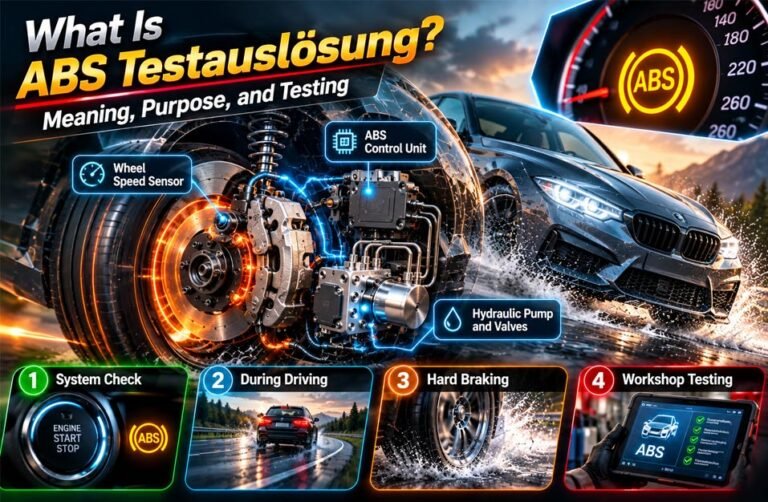
ABS Testauslösung is a German term that means testing or activating a car’s Anti-lock Braking System (ABS). This system helps stop the wheels from locking during hard braking. It also helps drivers control their cars.
People often search for ABS Testauslösung when they see an ABS warning light, hear clicking sounds, or feel the brake pedal shaking. This article explains what ABS Testauslösung means, how it works, why it is tested, and what problems can affect it.
What Is ABS Testauslösung?
ABS Testauslösung means testing or activating a car’s Anti-lock Braking System. The test helps check whether the system is working properly.
ABS stands for Antiblockiersystem in German. The word Testauslösung means test activation or triggering.
A car may check its ABS automatically when it starts. Mechanics can also test the system using special diagnostic tools. ABS may also activate during hard braking.
ABS Testauslösung is not a specific car error code. Its meaning depends on the vehicle and the type of test.
What Is the Purpose of ABS Testauslösung?
The main purpose of ABS Testauslösung is to check whether the braking system works correctly.
It helps mechanics find problems and check whether repairs have fixed them.
Some important purposes include:
- Check ABS parts: Make sure the sensors, pump, and valves respond correctly.
- Find problems: Identify possible faults in the braking system.
- Check repairs: Confirm that the system works after repairs.
- Help drivers: Teach drivers how ABS feels during hard braking.
- Improve safety: Help find problems that may affect braking control.
A successful test is useful, but it does not mean every part of the braking system is perfect.
How Does the ABS System Work?
ABS uses sensors and electronic parts to control brake pressure.
When a driver brakes hard, the system checks how fast the wheels are turning. If a wheel is about to lock, ABS changes the brake pressure to help it keep moving.
Wheel Speed Sensors
Wheel speed sensors check how fast each wheel is turning.
They send this information to the ABS control unit. This helps the system know when a wheel may lock.
If a sensor is damaged or sends wrong information, ABS may not work correctly.
ABS Control Unit
The ABS control unit receives information from the wheel speed sensors.
It checks whether any wheel is slowing too quickly. If a wheel may lock, the control unit tells the hydraulic system to change the brake pressure.
Hydraulic Pump and Valves
The hydraulic unit uses valves and a pump to control brake pressure in many ABS systems.
It works in three main steps:
- Reduces brake pressure when a wheel may lock.
- Holds the pressure while checking wheel movement.
- Increases pressure when the wheel can turn properly.
These steps happen very quickly.
Drivers may feel the brake pedal shaking or hear clicking sounds when ABS is working.
How ABS Prevents Wheel Locking
Wheel locking happens when a wheel stops turning while the car is still moving.
This can make steering difficult, especially on slippery roads.
ABS changes the brake pressure to help the wheels keep turning. This allows the driver to steer more easily during hard braking.
However, ABS cannot stop every accident. Braking distance still depends on road conditions, tires, and vehicle speed.
When Does ABS Testauslösung Happen?
ABS Testauslösung can happen when a car starts, begins moving, or brakes hard.
Mechanics may also test ABS when checking or repairing a vehicle.
During Vehicle Startup
When a car starts, its ABS may perform an automatic check.
The ABS warning light usually appears briefly on the dashboard and then turns off.
This is normal in many vehicles.
If the light stays on, there may be a problem that needs checking.
When the Vehicle Starts Moving
Some cars perform another ABS check shortly after they start moving.
During this check, drivers may hear a short clicking or buzzing sound. Some vehicles may also produce a small vibration.
These sounds can be normal.
However, not every car makes these sounds, and the testing speed depends on the vehicle.
During Hard Braking
ABS activates when a wheel may lock during hard braking.
This often happens on wet, icy, snowy, or slippery roads. It can also happen during very hard braking on dry roads.
Drivers may notice:
- The brake pedal shaking.
- Clicking or buzzing sounds.
- Quick changes in brake pressure.
These are common signs that ABS is working.
During emergency braking, drivers should keep firm pressure on the brake pedal instead of pumping it.
During Workshop Testing
Mechanics may test ABS when a warning light appears or the car has braking problems.
They may also test it after certain repairs.
Special diagnostic tools help them check the sensors, pump, valves, and other parts.
Types of ABS Testing
There are three main ways to test a car’s ABS system.
Automatic ABS Self-Test
An automatic ABS self-test happens when the car checks its own braking system.
Depending on the vehicle, this may happen during startup or shortly after the car begins moving.
The system checks for certain problems with its electronic parts.
If it finds a fault, the ABS warning light may appear.
However, this test cannot find every possible problem.
Diagnostic ABS Activation Test
A diagnostic ABS test is usually performed by a mechanic.
The mechanic connects a special scanner to the car. This scanner can read ABS fault codes and check different parts.
Depending on the vehicle, it may help the mechanic:
- Read ABS error codes.
- Check wheel speed sensors.
- Test the ABS pump.
- Check hydraulic valves.
- Confirm whether repairs worked.
Not every OBD2 scanner can perform these tests. Some scanners only check engine problems.
Controlled ABS Braking Test
A controlled braking test checks how ABS works during hard braking.
This test is usually performed in a safe testing area or during professional driving training.
When ABS activates, the driver may feel the brake pedal shaking.
Drivers should not deliberately test ABS by braking hard on public roads. It can be dangerous.
How Do Mechanics Perform an ABS Testauslösung?
Mechanics use special tools to find ABS problems and check whether the system works correctly.
The testing process depends on the car and the problem.
Step 1: Connect a Diagnostic Scanner
The mechanic connects a scanner to the car’s diagnostic port.
The scanner reads stored ABS fault codes. These codes help show which part of the system may have a problem.
Step 2: Check Wheel Speed Sensor Data
The mechanic checks the information coming from each wheel speed sensor.
If one sensor gives unusual readings, the mechanic may check its wiring, wheel bearing, or related parts.
Step 3: Test the ABS Pump and Valves
Some diagnostic scanners can activate the ABS pump and valves.
This helps the mechanic check whether these parts respond correctly.
The test must follow the car manufacturer’s instructions.
Step 4: Check the Hydraulic System
If the braking system has been repaired or opened, the mechanic may need to check for trapped air.
Some cars require a special brake bleeding process using a diagnostic tool.
However, this is not needed after every brake repair.
Step 5: Verify the Repair
After fixing the problem, the mechanic checks the ABS again.
This may include checking fault codes, reading sensor information, and performing a safe road test.
The goal is to make sure the original problem has been fixed.
ABS Warning Lights and What They Mean
The ABS warning light appears on the dashboard when the system performs a check or detects a problem.
It normally turns on briefly when the car starts and then turns off.
If it stays on, the ABS may have a fault.
| Warning Light | Possible Meaning |
|---|---|
| Appears briefly at startup | Normal system check |
| Stays on after starting | Possible ABS problem |
| Appears while driving | System may have detected a fault |
| ABS and traction control lights appear | Possible problem with shared parts |
| ABS and red brake warning lights stay on | Possible serious braking problem |
An ABS warning light does not tell you exactly which part is damaged.
A mechanic may need to use a diagnostic scanner to find the cause.
If the red brake warning light also stays on, stop safely and get professional help.
Common Signs of ABS Problems
ABS problems may cause warning lights, unusual sounds, or changes in braking.
Common signs include:
- ABS warning light stays on: The system may have found a problem.
- ABS activates during gentle braking: A sensor may be sending incorrect information.
- Unusual brake pedal feel: There may be a problem with the braking system.
- Repeated clicking sounds: Unusual noises may need checking.
- Incorrect sensor readings: A sensor or nearby part may be damaged.
- Failed ABS test: The pump, valves, or electronic parts may not work correctly.
A shaking brake pedal during hard braking is usually normal ABS behavior. However, shaking during ordinary braking may have another cause, such as worn or uneven brake discs.
Common Causes of ABS Testauslösung Problems
ABS problems can happen because of damaged sensors, wiring, hydraulic parts, or electrical faults.
Faulty Wheel Speed Sensors
Wheel speed sensors may stop working because of dirt, corrosion, or damage.
Wrong sensor readings can cause the ABS warning light to appear or make ABS activate at the wrong time.
Solution: A mechanic should check the sensor and its connections. Replace the sensor if it is faulty.
Damaged Wiring and Connectors
Broken wires, loose connections, and corrosion can stop ABS parts from communicating properly.
Some wiring problems happen only sometimes, making them difficult to find.
Solution: Check the wires and connectors. Repair or replace damaged parts.
Hydraulic Pump or Valve Problems
The ABS pump and valves help control brake pressure.
If they stop working correctly, ABS may not be able to control the brakes as needed.
Solution: A qualified mechanic should test the hydraulic unit and repair or replace faulty parts.
Wheel Bearing and Encoder Ring Problems
Some ABS sensors use an encoder ring to measure wheel movement.
A damaged ring or wheel bearing can cause incorrect readings.
Solution: Check the wheel bearing, encoder ring, and sensor position. Repair the damaged part.
Battery and Control Module Problems
A weak battery, damaged fuse, or faulty control unit can affect ABS operation.
The system needs a steady electrical supply to work correctly.
Solution: Check the battery, charging system, fuses, and electrical connections. Further testing may be needed if the problem continues.
ABS Testauslösung After Repairs and Maintenance
ABS testing may be needed after certain brake repairs.
For example, a mechanic may check the system after replacing a wheel speed sensor, repairing wiring, or working on the hydraulic unit.
A diagnostic scanner can help confirm that the repaired parts are working.
If the hydraulic system was opened, brake bleeding may also be necessary.
Some vehicles need a special scanner for this process. However, not every brake repair requires an ABS activation test.
The mechanic should follow the vehicle manufacturer’s instructions.
ABS Testauslösung vs. Normal Braking
Normal braking and ABS activation both help slow down a vehicle, but they work differently.
During normal braking, the driver controls the brakes through the pedal.
During ABS activation, the system changes brake pressure when a wheel may lock.
| Normal Braking | ABS Activation |
|---|---|
| Slows the car without ABS intervention | Changes pressure to help prevent wheel locking |
| Brake pedal usually feels steady | Brake pedal may shake |
| Happens during everyday driving | Happens during hard braking or slippery conditions |
| ABS pressure control is not needed | Helps the driver maintain steering control |
During emergency braking, drivers should press the brake pedal firmly and keep pressing it.
ABS automatically controls the pressure, so drivers do not need to pump the pedal.
Benefits and Limitations of ABS Testing
ABS Testauslösung helps mechanics check the braking system and find possible problems.
However, it cannot guarantee that the system will always work perfectly.
Benefits
- Find problems early: Helps detect some faults before they become serious.
- Better diagnosis: Helps mechanics find damaged or faulty parts.
- Check repairs: Helps confirm whether a repair worked.
- Driver awareness: Helps drivers understand how ABS feels.
- Vehicle safety: Supports proper brake maintenance.
Limitations
- A successful test cannot guarantee that ABS will always work.
- Some problems only appear during certain driving conditions.
- Basic scanners may not support ABS testing.
- Incorrect testing can be dangerous.
- Some faults need further professional inspection.
ABS testing is useful, but regular brake maintenance is still important.
Can You Perform ABS Testauslösung Yourself?
Drivers can check some basic signs of ABS operation.
For example, you can see whether the ABS warning light turns on briefly when starting the car and then turns off.
You can also notice unusual sounds or changes in braking.
However, these simple checks cannot confirm that every ABS part works correctly.
Do not deliberately brake hard on public roads just to test ABS.
You should also avoid using diagnostic tools that are not suitable for your vehicle.
For a complete ABS test, visit a qualified mechanic.
What Should You Do if the ABS Warning Light Stays On?
If the ABS warning light stays on, the system may have detected a problem.
Some cars can still brake normally when ABS is not working. However, the wheels may lock during hard braking.
If the ABS warning light stays on:
- Read your car’s owner’s manual.
- Check whether other brake warning lights are also on.
- Do not assume ABS is working.
- Arrange a professional inspection soon.
- Follow the manufacturer’s advice about driving.
If the red brake warning light appears or the brakes feel unusual, stop in a safe place and get professional help.
Do not continue driving if the braking system may have a serious problem.
ABS vs. ESP and Traction Control
ABS, ESP, and traction control are vehicle safety systems. They have different jobs but often use some of the same parts.
ABS (Anti-lock Braking System)
ABS helps stop wheels from locking during hard braking.
It allows drivers to maintain better steering control.
ESP or ESC (Electronic Stability Control)
ESP helps keep the car stable when it begins to skid.
It can apply braking force to certain wheels to help the driver maintain control.
Traction Control System (TCS)
Traction control helps stop wheels from spinning too much during acceleration.
It is useful on wet, snowy, and slippery roads.
These systems may share wheel speed sensors. Because of this, one faulty sensor can sometimes cause several warning lights to appear.
Does ABS Testauslösung Have Another Meaning?
Yes. ABS Testauslösung can also mean testing an avalanche airbag backpack.
ABS is also the name of a company that makes avalanche safety backpacks.
These backpacks have airbags that can inflate during an avalanche to help reduce the risk of being buried.
There are two common testing methods:
- Full deployment test: The airbags are released and inflated.
- Dry trigger test: On supported models, the release handle is tested without inflating the airbags.
ABS avalanche backpacks include systems such as EASY.TECH, SOLID, and p.RIDE.
Each system has its own testing instructions. Some full tests require a cartridge to be refilled or replaced afterward.
This type of ABS Testauslösung is different from testing a car’s braking system.
Bottom Line
ABS Testauslösung means testing or activating a car’s anti-lock braking system. It helps check whether ABS works correctly and can help find braking problems.
Clicking sounds, brief warning lights, and brake pedal vibrations can be normal. However, warning lights that stay on or unusual braking behavior should be checked.
Drivers should follow their car manufacturer’s instructions and visit a qualified mechanic when professional ABS testing is needed.
Frequently Asked Questions
What does ABS Testauslösung mean in English?
ABS Testauslösung means ABS test activation. It means checking a car’s anti-lock braking system.
Is ABS Testauslösung normal?
Yes, ABS testing during startup or hard braking is normal. A warning light that stays on may mean a problem.
Why does my car make a clicking sound after starting?
Some cars make clicking sounds during ABS checks. This is usually normal, but repeated sounds may need checking.
Does ABS activation mean my brakes are faulty?
No, ABS normally works during hard braking. If it activates during gentle braking, there may be a problem.
Can I drive with the ABS warning light on?
Your brakes may still work, but ABS may not. Have your car checked soon and stop safely if braking feels unusual.
Can a regular OBD2 scanner test ABS?
Not always. Most basic scanners check engine problems, while ABS testing may need a special scanner.
How often should ABS Testauslösung be performed?
There is no fixed time. Test ABS when problems appear, after certain repairs, or when the car manufacturer recommends it.
Can ABS Testauslösung damage the braking system?
Proper testing is normally safe. Wrong tools or testing methods may cause problems.
Discover More:
Messagenal: Communication Features, Benefits, and Important Facts
