


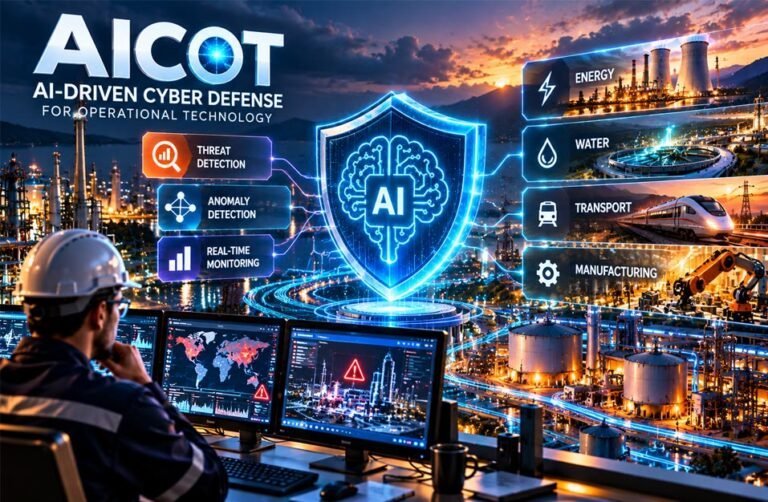
AICOT is a European cybersecurity project that aims to protect industrial systems using artificial intelligence (AI). It focuses on Operational Technology (OT), which is used to control machines and equipment in power plants, water facilities, factories, and transport systems.
AICOT is being developed to help security teams find cyber threats and protect important services. This article explains what AICOT is, how it works, its main technologies, benefits, limitations, and future plans.
What Is AICOT?
AICOT is a European project that uses AI to improve cybersecurity in industrial systems. Its full project description is AI-Driven Cyber Defense Platform for Operational Technology Environments in Critical Infrastructure.
The project aims to build a platform that can monitor industrial networks, find unusual activity, and help security teams detect possible cyberattacks.
Unlike normal antivirus software, AICOT focuses on systems that control real machines. These include industrial equipment, sensors, electrical systems, and automated machines.
AICOT plans to use AI, security monitoring, industrial network analysis, and information about cyber threats.
The project is still being developed and tested. Its planned features should not be treated as fully tested commercial tools.
Who Is Behind AICOT?
AICOT is led by Logstail, a cybersecurity company. The project uses Logstail’s existing security monitoring and data analysis technology.
Logstail is responsible for developing the platform, studying AI security methods, and preparing the system for testing in industrial environments.
AICOT receives funding from the European Union’s Digital Europe Programme. Its grant agreement number is 101249826.
The project also supports Europe’s goal of building its own cybersecurity technology. This can help European countries have more control over the technology used to protect important services.
According to the project information, Logstail leads a single-member consortium.
Why Operational Technology Needs Cybersecurity
Operational Technology, or OT, includes the hardware and software used to control machines and physical equipment.
It is used in power stations, water treatment plants, factories, and transport systems.
OT systems include Programmable Logic Controllers (PLCs), Supervisory Control and Data Acquisition (SCADA) systems, sensors, and industrial controllers.
For example, a PLC can control a water pump. A SCADA system allows workers to monitor and manage industrial equipment.
OT security is different from normal IT security. IT systems mainly manage computers, files, and business information. OT systems control machines and physical operations.
A cyberattack on an industrial system can stop production, damage equipment, or interrupt important services.
Many industrial facilities also use old machines that were not designed for modern cyber threats. These systems can be difficult to update because stopping them may affect daily operations.
Industrial networks are also becoming more connected to office computers, cloud services, and remote access tools. These connections can create new security risks.
AICOT aims to help protect these systems while allowing important operations to continue safely.
How AICOT Works
AICOT is being developed to collect and study security information from industrial networks.
The planned platform can use information from network traffic, device activity, security records, and industrial control systems.
This information helps the system understand how machines normally work and communicate.
For example, a controller may communicate with the same machines every day. If it suddenly connects to an unknown device, the system could mark this activity as unusual.
AICOT aims to study different events together. An unusual login, a new device connection, and an unexpected machine command may be signs of a possible attack.
AI can help identify these patterns and show useful information to security teams.
Security experts can then review the alerts and decide what action is needed.
Human review is important because stopping or changing an industrial machine without proper checks could create safety problems.
Artificial Intelligence and Machine Learning in AICOT
Artificial intelligence is one of the main technologies used in the AICOT project.
Industrial networks produce large amounts of information from machines, sensors, and security systems. Checking every record by hand can take a lot of time.
AI can help study this information and find activity that needs attention.
Machine learning allows computers to learn patterns from data. In industrial systems, many machines follow regular routines.
For example, a sensor may send information every few seconds. A controller may communicate with only a few known devices.
Machine learning can learn these normal patterns and identify changes, such as new connections, unusual commands, or unexpected network traffic.
AICOT also plans to explore generative AI and adversarial AI. These methods may help improve the detection of hidden or new cyber threats.
Adversarial AI can also be used to test security models with unusual or changed data.
However, AI cannot detect every attack. Its results depend on the quality of the data and how well the system has been trained.
Security professionals are still needed to check important alerts and make decisions.
AICOT Threat Detection and Anomaly Detection
Threat detection means finding signs of possible cyberattacks or harmful activity.
AICOT aims to improve threat detection by watching industrial networks and identifying unusual behavior.
One important method is anomaly detection. An anomaly is something that does not match normal activity.
For example, a machine may receive a command at an unusual time. An engineering computer may also connect to a controller it does not normally use.
These changes may need investigation, but they do not always mean an attack has happened.
Normal maintenance, equipment testing, software updates, and production changes can also create unusual activity.
AICOT aims to use information about machines, network activity, and known threats to help security teams understand these events.
The system must also deal with two common problems. A false positive happens when normal activity is marked as dangerous. A false negative happens when a real threat is missed.
Both problems matter because wrong alerts and missed attacks can affect important industrial operations.
SIEM Integration and Real-Time Security Monitoring
SIEM stands for Security Information and Event Management. It is technology that collects and studies security information from different systems.
A SIEM platform can collect login records, firewall activity, network events, and security alerts.
This allows security teams to review information from different sources in one place.
AICOT builds on Logstail’s existing SIEM and data analysis technology.
The project aims to add more information about industrial machines and control systems.
This is useful because normal security tools may show that two devices are communicating without explaining what those devices control.
AICOT aims to connect security events with industrial information to make alerts easier to understand.
For example, a remote login followed by access to an industrial computer and an unexpected machine command may need investigation.
Each event may look normal on its own. Together, they could show a possible security problem.
Real-time monitoring is another goal of AICOT. It aims to help security teams find suspicious activity quickly and respond before a problem becomes more serious.
Industrial Protocol Analysis in AICOT
Industrial machines use special communication rules called protocols. These rules allow devices to exchange information and send commands.
AICOT aims to study these communications to help find unusual or suspicious activity.
The project focuses on several industrial protocols:
- Modbus: Used for communication between industrial controllers and devices.
- DNP3: Commonly used in electricity and utility systems.
- PROFINET: Used for communication in industrial automation.
- IEC 61850: Used in electrical power systems and automation.
Normal network security tools may show which devices are communicating. However, they may not fully understand the commands being sent.
Industrial protocol analysis helps security teams understand these messages.
For example, a command that changes a machine’s settings may need attention if it comes from an unknown device or arrives at an unusual time.
AICOT aims to use this information to find unexpected commands, unusual connections, and possible security threats.
Cyber Threat Intelligence and Secure Data Sharing
Cyber Threat Intelligence (CTI) is information about cyberattacks, security risks, and methods used by attackers.
It helps security teams understand known threats and identify similar activity in their systems.
AICOT aims to combine this information with industrial security monitoring.
Sharing threat information can help organizations protect their systems. However, industrial companies often have private information about their machines, networks, and security weaknesses.
Sharing this information without proper protection could create new risks.
AICOT plans to use blockchain technology to support secure sharing of threat information.
Blockchain can help keep records of shared information and make it easier to check whether the records have been changed.
The goal is to help organizations share useful security information while protecting private details.
However, the available sources do not confirm how the complete system will work or how well it will perform.
Where Can AICOT Be Used?
AICOT is designed for industries that use connected machines and industrial control systems.
Energy: Power plants and electricity networks use digital systems to control equipment. AICOT may help find unusual commands, network changes, and possible cyber threats.
Water: Water treatment plants use pumps, valves, and sensors. AICOT could help security teams monitor these systems and identify unusual activity.
Transportation: Transport systems use digital networks for communication and control. AICOT may help identify suspicious activity in these networks.
Manufacturing: Factories use automated machines and industrial controllers. AICOT could help monitor these devices and find changes that need investigation.
These are planned uses of AICOT. The available information does not confirm that the platform is already being used commercially in these industries.
Benefits of AICOT
AICOT aims to make industrial cybersecurity monitoring more useful and effective.
One possible benefit is better visibility. Industrial networks can contain many machines and devices. AICOT could help security teams understand how these systems communicate.
Another benefit is earlier threat detection. AI can help find unusual behavior that traditional security rules may not recognize.
AICOT also aims to provide clearer security alerts by connecting information from different systems.
The platform may work with existing security tools, allowing companies to improve monitoring without replacing all their current systems.
Secure threat information sharing could also help organizations learn about new cyber risks while protecting sensitive information.
These benefits are expected results of the project. They still need to be confirmed through testing.
Challenges and Limitations of AICOT
AICOT faces several challenges that are common in AI-based cybersecurity.
One problem is false alerts. AI may identify normal activity as dangerous, which can create unnecessary work for security teams.
Another problem is missed threats. A real cyberattack may not always be detected.
AI also needs reliable training data. However, detailed information about industrial cyberattacks can be difficult to collect.
Older machines may create problems because some do not support modern security technology.
Industrial environments are also different from one another. A system trained in one factory may not work equally well in a power plant or water facility.
Security alerts must be clear enough for workers to understand. They need to know why the system has identified something as suspicious.
The available sources do not provide confirmed figures for AICOT’s detection accuracy, response speed, or results from independent testing.
Is AICOT Safe and Reliable?
AICOT is being developed to improve industrial security, but its safety and reliability will depend on proper testing and use.
Industrial systems control real machines. A wrong security action could stop equipment, interrupt production, or affect important services.
For this reason, security experts should review important AI alerts before making major changes.
Industrial engineers may also need to help decide whether an action is safe.
Organizations should use strong passwords, access controls, secure network settings, backups, and clear security procedures.
Privacy is another concern. Industrial monitoring can collect sensitive information about equipment and network activity. This information needs proper protection.
AICOT should work alongside other cybersecurity tools rather than replace them.
Its real-world safety and reliability have not been independently confirmed in the supplied sources.
AICOT Development Status and Future Plans
AICOT is currently described as a research and development project.
Its goal is to build an AI-powered cybersecurity platform and test it in realistic industrial environments.
The project aims to reach Technology Readiness Levels (TRL) 7–8. These levels show how close a technology is to practical use.
TRL 7 means a system prototype has been demonstrated in an operational environment.
TRL 8 means the system is complete and has passed important tests.
AICOT aims to reach these levels through development and testing. This does not mean it has already achieved them.
Testing will help show how accurately the platform detects threats, how quickly it works, and whether it can operate safely with industrial equipment.
The project also supports Europe’s goal of developing more of its own cybersecurity technology.
The available sources do not confirm a public release date, subscription plans, or commercial pricing for AICOT.
Its future availability will depend on development progress and testing results.
AICOT vs. Traditional Cybersecurity Tools
Traditional cybersecurity tools protect computers and networks using firewalls, antivirus software, access controls, and known attack patterns.
AICOT aims to add AI-based monitoring and industrial network analysis.
The main difference is its focus on machines, industrial communication, and unusual behavior.
| Feature | Traditional Cybersecurity | AICOT’s Planned Approach |
|---|---|---|
| Main Focus | Computers and networks | Industrial systems and OT |
| Threat Detection | Security rules and known threats | AI and behavior analysis |
| Industrial Protocols | Depends on the tool | Industrial protocol analysis |
| Monitoring | Logs and network activity | Security data and industrial activity |
| Threat Intelligence | Available in many tools | Secure information sharing is planned |
| Availability | Many commercial products | Still in development and testing |
AICOT is not meant to replace traditional security tools.
Instead, it aims to add another layer of protection for industrial networks.
Organizations will still need security experts, strong access controls, and proper plans for handling cyber incidents.
Bottom Line
AICOT is a European cybersecurity project that aims to protect industrial systems using artificial intelligence.
It plans to combine machine learning, anomaly detection, industrial protocol analysis, and threat intelligence to help security teams identify possible attacks.
The project is still being developed and tested. Its future success will depend on reliable results, safe operation, and proper use by cybersecurity professionals.
Frequently Asked Questions
What is AICOT used for?
AICOT is being developed to monitor industrial networks, find unusual activity, and help security teams detect possible cyber threats.
What does AICOT stand for?
AICOT is linked to the project description AI-Driven Cyber Defense Platform for Operational Technology Environments in Critical Infrastructure. A separate letter-by-letter meaning is not confirmed.
Who is developing AICOT?
AICOT is led by Logstail and receives funding through the European Union’s Digital Europe Programme.
How does AICOT use artificial intelligence?
AICOT aims to use AI and machine learning to study industrial activity, find unusual patterns, and help detect possible threats.
Which industries can benefit from AICOT?
AICOT focuses on industries such as energy, water, transport, and manufacturing that use industrial control systems.
Can AICOT detect unknown cyber threats?
AICOT aims to find unusual activity that may be linked to new threats. However, it cannot guarantee that every attack will be detected.
Is AICOT available for commercial use?
The available sources describe AICOT as a development and testing project. Public pricing and commercial availability are not confirmed.
Can AICOT replace cybersecurity professionals?
No. AICOT is designed to help security teams. Human experts are still needed to review alerts and make safe decisions.
Discover More:
